LightBlog

jeudi 28 novembre 2019

LineageOS 16 arrives officially for the Asus ZenFone Max Pro M2, ZenFone 3, Yandex Phone, Galaxy S3 Neo, Xiaomi Redmi Note 4X, Xperia Z3 Compact, and Moto G7

Over the last couple of months, several devices have received official LineageOS 16 builds. These builds not only give older devices a new lease on life but also give users the chance to experience Android 9 Pie on their devices. Thanks to this, users with devices like the Samsung Galaxy S4, Galaxy S4 Active, Moto X (2014), and LG G3 can now enjoy all the new features Google introduced in Android Pie. Now, the LineageOS team has extended support for a few more devices and has released official Android 9 Pie-based builds for the Asus ZenFone Max Pro M2, ZenFone 3, Yandex Phone, Galaxy S3 Neo, Redmi Note 4X, Xperia Z3 Compact, and the Moto G7.

Asus ZenFone Max Pro M2

The ZenFone Max Pro M2 is one of the best budget handsets to come out of Asus’ stable. While the company has officially released an Android 9 Pie build for the device, in case you’re not satisfied with the stock ROM you’d be glad to know that the LineageOS team has now officially announced support for the device. Currently, there are no LineageOS 16 builds for the device, but you can check the download page linked below to find new builds as they go live.

LineageOS 16 for the Asus ZenFone Max Pro M2

Asus ZenFone Max Pro M2 XDA Forums

Asus ZenFone 3

The ZenFone 3 from 2016, which was only upgraded to Android 7 Nougat, has also received official support for LineageOS 16. The latest builds for the device bring all of Android Pie features to the dated device and offer a near-stock Android experience with plenty of customization options.

LineageOS 16 for the Asus ZenFone 3

Asus ZenFone 3 XDA Forums

Yandex Phone

Similarly, the Yandex Phone from Russian search giant Yandex has also received support for LineageOS 16. The device was launched late last year with Android 8.1 Oreo and with the latest LineageOS builds, users will be able to enjoy Android 9 Pie on their device.

LineageOS 16 for the Yandex Phone

Samsung Galaxy S3 Neo

The Samsung Galaxy S3 Neo from 2014, which launched with Android 4.3 Jelly Bean, has also received an Android 9 Pie-based build of LineageOS 16. You can download the build on your device from the link below, but make sure you install the correct variant or you might end up bricking your device.

LineageOS 16 for the Galaxy S3 Neo (Samsung Camera)/Galaxy S3 Neo (Sony Camera)

Samsung Galaxy S3 Neo XDA Forums

Xiaomi Redmi Note 4X

The Xiaomi Redmi Note 4X from 2017 has also received official support for LineageOS 16, allowing users to experience close to stock Android 9 Pie on their devices.

LineageOS 16 for the Xiaomi Redmi Note 4X

Sony Xperia Z3 Compact

In case you have a Sony Xperia Z3 Compact lying around, you can now breathe new life into the device thanks to this LineageOS 16 build. The device, which launched back in 2014, was only upgraded to Android 6.0 Marshmallow, so it’s great to see developers adding Android 9 Pie support for such a date device.

LineageOS 16 for the Sony Xperia Z3 Compact

Sony Xperia Z3 Compact XDA Forums

Moto G7

Finally, the Moto G7 from earlier this year has also received LineageOS 16 builds based on Android 9 Pie. While the device was launched with Android 9 Pie out of the box, you can check out this build if you’re not satisfied with the stock ROM and would like additional customization features.

LineageOS 16 for the Moto G7

Moto G7 XDA Forums


Try out these builds and share your thoughts in the comments below!

The post LineageOS 16 arrives officially for the Asus ZenFone Max Pro M2, ZenFone 3, Yandex Phone, Galaxy S3 Neo, Xiaomi Redmi Note 4X, Xperia Z3 Compact, and Moto G7 appeared first on xda-developers.


from xda-developers https://ift.tt/2Os08sv
via IFTTT

Google Pay (Tez) for India prepares to add gold gifting option

Google Pay is Google’s unified payment platform, but the company also has an app with the same name but different functionality for users in India. This India-only Google Pay is a rebrand of the erstwhile Google Tez, and the app has gone on to add more functionalities after the rebranding. A Material Theme redesign for the app is in the works, and now Google is planning to add gold gifting options to the payment app.

Google Pay (Tez) - a simple and secure payment app (To be announced, Google Play) →

Google Pay (Tez) for India introduced an option to purchase gold in April 2019. Gold occupies a special place in Indian culture, and the same is reflected in the fact that India is the second-largest consumer of gold in the world. Google had partnered with MMTC-PAMP India to allow users to buy 99.99% 24 karat gold from within the Google Pay (Tez) app. Users can purchase gold for any value, big or small, and the same is digitally stored in a Gold Accumulation Plan (GAP) by MMTC-PAMP, and physically stored in secure vaults on behalf of the user. These purchases are claimed to be 100% insured.

Gold purchased through the Google Pay account appears digitally in the Gold Vault within the app, which is essentially a visual representation of the GAP account balance. Gold that has been purchased can be sold from within Google Pay at any time at prices which are claimed to be refreshed every few minutes. You can also have your gold physically delivered to you, though this feature is available at a few locations only.

An APK teardown can often predict features that may arrive in a future update of an application, but it is possible that any of the features we mention here may not make it in a future release. This is because these features are currently unimplemented in the live build and may be pulled at any time by the developers in a future build.

Google Pay (Tez) v48.0.001_RC03 contains new strings that indicate that Google is moving one step forward and allowing users to gift gold to each other.

<string name="gold_gifting_description_hint">Add a personal note</string>
<string name="gold_gifting_gifting_subject">"Gift gold to %1$s"</string>
<string name="gold_gifting_milligram_quantity_symbol">%1$s mg</string>
<string name="gold_ui_gift_output_text">Worth %1$s based on current selling price.</string>
<string name="gold_ui_header_gift_title">How much gold to gift?</string>

As usual, this feature is not yet live within the latest version of the app from the Google Play Store. We expect Google to formally announce the feature when it is ready for rollout. While gifting gold will be made significantly easier with this option, keep in mind that gifting gold does have tax implications in India.


Thanks to PNF Software for providing us a license to use JEB Decompiler, a professional-grade reverse engineering tool for Android applications.

The post Google Pay (Tez) for India prepares to add gold gifting option appeared first on xda-developers.


from xda-developers https://ift.tt/2OPzskx
via IFTTT

ASUS finally rolls out Android Pie for the first gen ROG Phone

Asus has been doing a fine job of delivering updates to its latest flagship devices. Earlier this month, the company rolled out a stable Android 10 build for the ZenFone 6/6Z and recruited beta testers for the ROG Phone II. Most recently, the company rolled out a stable Android 10 update for last year’s ZenFone 5Z. However, it hasn’t extended the same priveledges to some other devices. For instance, the company dropped plans to update the ZenFone 4 to Android Pie late last month. Thankfully though, it doesn’t seem like the first-gen ROG Phone is going to get the same treatment.

The first-gen ROG Phone, which was announced last year in July, came with Android 8.1 Oreo out of the box. Over a year after Google rolled out Android 9 Pie on the Pixel 3 and Pixel 3 XL, the ROG Phone is receiving its first stable build of the software. As per a recent post on Asus’ ZenTalk forums, the latest update for the ROG Phone (v16.0410.1910.91) upgrades the system to Android P and brings a couple of changes to Asus’ ZenUI. Here are the official release notes for the Android 9 Pie update for the ROG Phone:

  • Upgraded system to Android P
  • Removed PAge Marker, ZeniMoji, Report Location in Safeguard, weather animation setting, AI Charging
  • Removed the Yandex cloud operation of File Manager application
  • Upgraded Game Center to Armoury Crate with whole new design
  • Added “Adaptive brightness”, “Adaptive Battery”, “New notifications”, “Status bar icon manager”, “Screen recorder”, and “Local backup” in Settings
  • Upgraded Game Genie panel with new design and features
  • Added Android P “Swipe up on Home button” gesture
  • Support 24-hour forecast in Weather application
  • Revamped Mobile Manager, Contacts, File Manager, Calculator, Clock, Gallery, and Weather applications
  • Redesigned volume control panel following Android P

The OTA update for the ROG Phone is being rolled out in a staged fashion and will only reach a few users initially. You can check for the update in the System updates section from within the device settings. The update should reach your device over the next couple of days, in case you haven’t received it already.


Source: Asus ZenTalk

The post ASUS finally rolls out Android Pie for the first gen ROG Phone appeared first on xda-developers.


from xda-developers https://ift.tt/33rER6v
via IFTTT

[Update: New 55″ 4K model]The new 65″ Mi TV 4X is the largest Xiaomi TV in India, 43″ and 50″ added to the 4K lineup

Update 1 (11/28/19 @ 03:15 AM IST): Xiaomi has announced a new 55″ model in the 4K Mi TV 4X series, which was launched in September. It will be available for sale in India starting 12/2/19 at noon via Amazon and Mi.

The original launch article from September 17, 2019, continues below.

Buy in India: Mi TV 4X 65″ (₹54,999 on Flipkart) || TV 4X 50″ (₹29,999 on Amazon India) || TV 4X 43″ (₹24,999 on Flipkart)

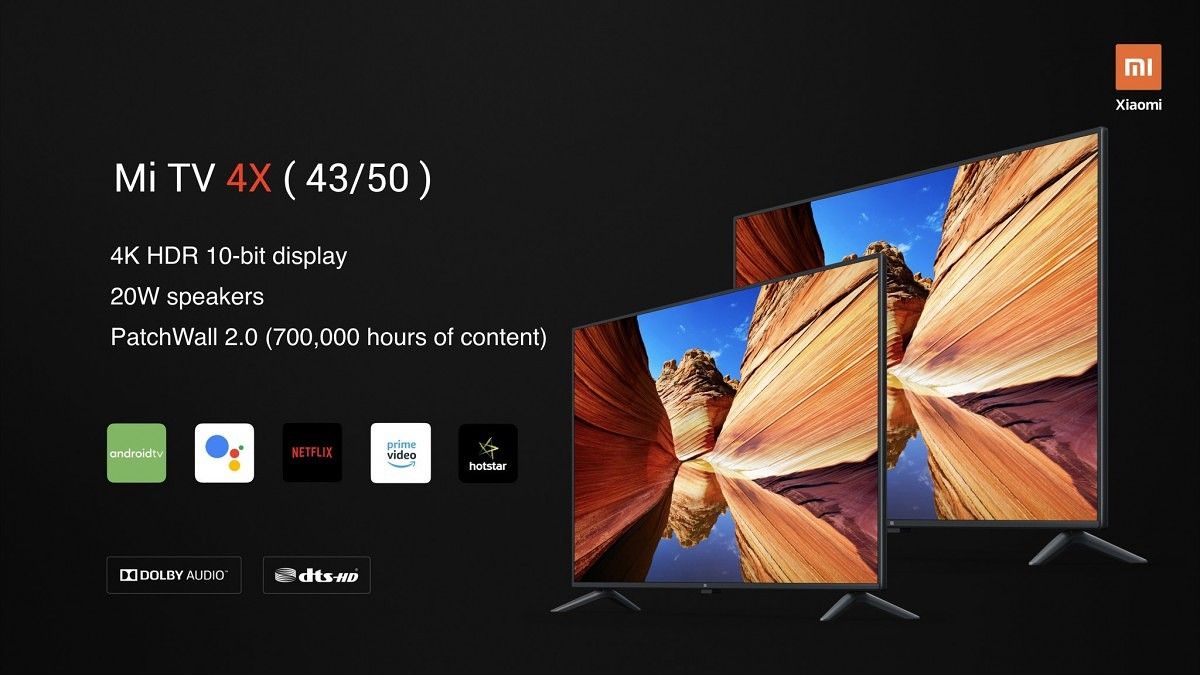
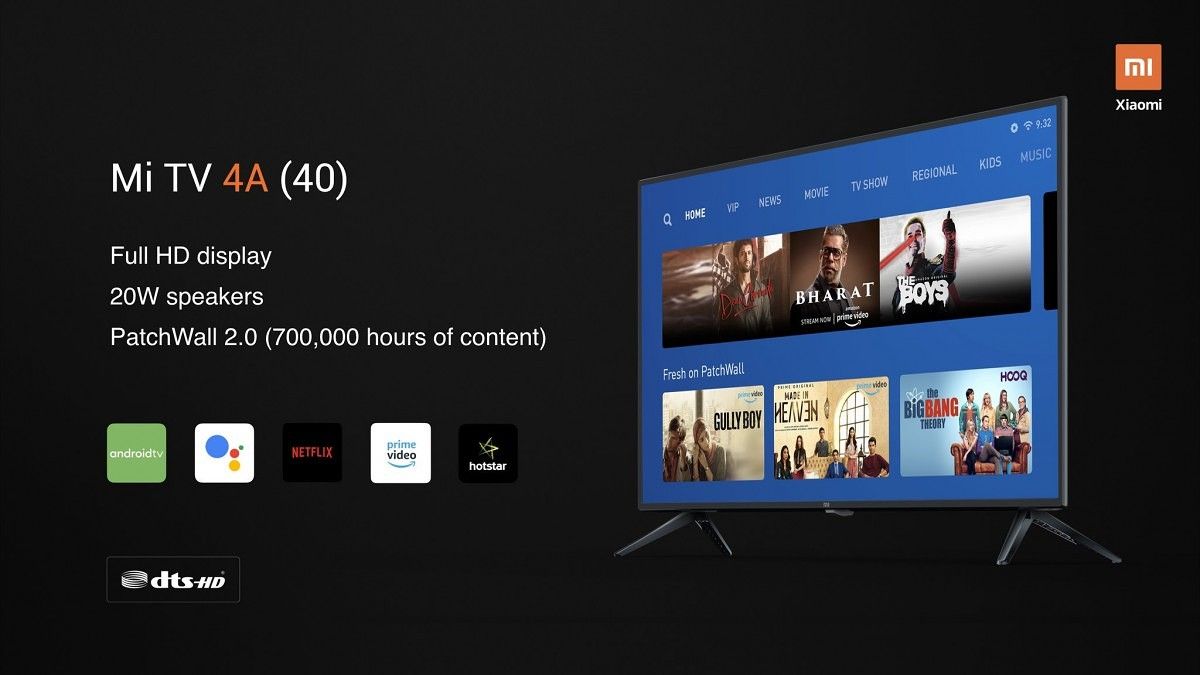
After taking the smartphone segment in India by a storm with its cost-effective offerings, Xiaomi entered the smart TV segment in India in early 2018. In less than two years, the company has been able to surpass legacy brands such as LG, Samsung, and Sony with its affordable smart and Android TVs. The company claims to have sold 3 million units so far and have captured 55% of online TV sales in India. Today, they are launching four new smart TVs in India to bolster its Mi TV lineup. The new series includes the Mi TV 4X 65″ with a 4K panel, which will be the largest Xiaomi Android TV in India, along with the Mi TV 4X 55″ and 43″ variants, and Mi TV 4A 40″.

Mi TV 4X 65-inch

The 4K UHD panel used by Xiaomi on the TV has a 60Hz refresh rate and a response time of 8 milliseconds. It displays 88% of the colors in the NTSC gamut and has a contrast ratio of 1200:1. The screen has a viewing angle of 178° so that the video content can be enjoyed by users sitting across at different angles and distances to the TV. Xiaomi is banking on something called a “Vivid Picture Engine,” a custom engine to optimize the color saturation, contrast, and brightness of content from all sources. Further, the custom Reality Flow chip will interpolate frames in the 24fps content on the Mi TV 4X 65″ to display 60fps content.

In terms of audio, the Mi TV delivers 20W audio with the help of four drivers, which includes two tweeters and two sub-woofers. The TV features support for Dolby Audio and is tuned for DTS-HD audio decoding.

Internally, the Mi TV is powered by a quad-core CPU by Amlogic with each core clocked at a maximum of 1.5GHz. This is paired with a 750MHz Mali-450 GPU and 2GB of RAM. While there’s an 8GB eMMC storage on the TV, you can use one of the two USB ports to add an external source of storage. Alternatively, you can use one of the three HDMI ports to input a stream of content to be enjoyed on the TV.

xiaomi mi tv 4x 65

While we’re not sure if the 8GB storage will be adequate, you can stream a variety of content directly on to the Mi TV  using either the dual-band Wi-Fi or the ethernet connectivity options. Xiaomi has optimized the PatchWall UI majorly to improve content discovery. It has partnered with various content providers and app developers to show live tiles of content in the PatchWall UI. If you prefer so, you can also switch to the default Android TV interface using the dedicated button on the remote. Xiaomi is also adding a few more content partners.

After much anticipation, Netflix is also coming to Mi TVs while Amazon Prime Video app will not only be supported but also be available on new Mi TVs out-of-the-box. The TVs will also support streaming 4K video content via Prime Video, Netflix, Hungama, etc.

The Mi TV remote controller also features a dedicated button to wake the Google Assistant as well a microphone to communicate with her. This new remote controller also gets dedicated buttons for Netflix and Prime Video.

Mi TV 4X 50″, 4X 43″, and Mi TV 4A 40″

Xiaomi has also announced two smaller 4K TV with the objective of making 4K TVs available to all users. These TVs comes with the same smart features, as well as the same picture and audio quality.

The company will also be offering a more affordable 40″ Mi TV will a Full HD panel and dual speakers.

mi tv 4a 40 inch mi tv 4a 40 inch

Data Saver & Cast to TV

As part of its customizations for users streaming content on their TVs using cellular data through mobile hotspots, Xiaomi has introduced a Data Saver feature which will consume one-third of data compared to when it runs on a Wi-Fi connection.

The Cast to TV feature will allow users to cast media files to their TV just like Chromecast but without any consumption of data.

Mi TV series: Pricing

The Mi TV 4X 65″ it will be priced at ₹54,999. The other 4K TVs – Mi TV 4X 50″ and the 43″ – will be available for ₹29,999 and ₹24,999, respectively.

The TV 4A 43″ with Full HD resolution will be available for ₹17,999.

All of these TVs will be via Amazon India and Mi online store starting September 29th.


Update 1: New 55″ 4K 2020 model

Xiaomi has launched a new 55-inch model in the two-months-old Mi TV 4X series with a 4K resolution. It has been branded with a 2020 tag but it looks much like the last year’s TV 4X Pro 55” which was launched in January this year, except for the newly added official Netflix support. The older TV is not likely to get Netflix even though older Mi TVs might. There’s 20W audio output through two full-range speakers. Another reason to buy the new 55″ model is its updated price, which is ₹5,000 less.

The Mi TV 4X 55″ will be available via Amazon India and the first sale will be held on December 2nd at noon. The TV will also be available offline at Mi Stores.


Disclosure: This article contains affiliate links. That means that if you make a purchase after clicking on a link, XDA-Developers may earn a small commission at no extra cost to you. This helps us pay for the many costs associated with running XDA-Developers, including server costs, full-time developers, news writers, and much more, and make it possible for us to continue serving you.

The post [Update: New 55″ 4K model]The new 65″ Mi TV 4X is the largest Xiaomi TV in India, 43″ and 50″ added to the 4K lineup appeared first on xda-developers.


from xda-developers https://ift.tt/31sOH8d
via IFTTT

Huawei Mate 30 Pro goes on sale in Indonesia with preloaded Huawei Mobile Services

All eyes were on Huawei when it took the stage on 19th September this year to unveil the new Huawei Mate 30 and Huawei Mate 30 Pro. The U.S. Government’s trade ban on the company affected its ability to serve its customers, not only in the USA but all around the world except its home country of China. The ban disallowed newer Huawei devices to ship with Google Mobile Services, meaning that users in these regions will not be able to experience Android in the same way as they used to. However, shipping without Google Services was already an ongoing reality in China, and Huawei had adapted itself to thrive in its home country. And because of the trade ban, Huawei now had to adopt the same solutions across regions outside of China. The Huawei Mate 30 Pro is now going on sale in more regions outside of China, like Indonesia, without Google Mobile Services, but using Huawei Mobile Services as the alternative.

Huawei Mobile Services comprises of three main pillars:

  1. Huawei AppGallery: an app distribution platform serving as an alternative to the Google Play Store, making it easy for developers to distribute apps to users, and for users to have a central location for downloading, installing and updating apps.
  2. HMS Core: background services that serve as an alternative to Google Play Services, making it feasible for developers to incorporate functionalities that they have come to expect from an OS.
  3. Huawei Ability Gallery: a service distribution platform for increased app discovery for developers and simplistic content aggregation for end-users.

These three main pillars combine to provide a comprehensive experience to both, end-users and developers, in the form of Huawei Mobile Services (HMS). Huawei has had the foresight to work on these solutions long before the trade ban situation came to exist, so these solutions are in surprisingly functional states already. While all stakeholders would have rested easy if the trade ban situation had resolved, Huawei is confident on its own HMS platform to proceed ahead with further launches. The Huawei Mate 30 Pro is thus launching in markets without GMS, but coming in with HMS as the primary platform.

Huawei Mate 30 Pro XDA Forums

Users in Indonesia can purchase the Huawei Mate 30 Pro from JD.com for Rp 12,499,000 (~$887) for the 8GB RAM plus 256GB storage variant, from November 30, 2019 onwards.


We thank Huawei for sponsoring this post and providing the content. Our sponsors help us pay for the many costs associated with running XDA, including servers, developers, writers, and more. While you may see sponsored content alongside Portal content, all of it will be clearly labeled as such. The XDA Portal team will not compromise journalistic integrity by accepting money to write favorably about a company. Our opinion cannot be bought. Sponsored content, advertising, and the XDA Depot are managed by our marketing director and not the editorial team.

The post Huawei Mate 30 Pro goes on sale in Indonesia with preloaded Huawei Mobile Services appeared first on xda-developers.


from xda-developers https://ift.tt/2Dn7MhJ
via IFTTT

OPPO Reno3 Pro 5G teaser shows off thinnest dual-mode 5G phone

As 5G adoption is picking up speed around the world, more and more smartphone manufacturers are releasing 5G devices in the market. Currently, manufacturers like Samsung, OnePlus, Huawei, Xiaomi, etc. offer 5G variants of their flagship devices in the market. Since these 5G devices are in the flagship category, they’re pretty much always out of the reach of the average consumer. To make the technology more accessible, Chinese manufacturers like Xiaomi and Realme are about to bring the next-gen of 5G smartphones, like the upcoming Redmi K30 and Realme X50, to the market that will offer dual-mode 5G at a relatively affordable price. Now, Oppo is looking to join the affordable dual-mode 5G club with the launch of the Reno3 Pro later this year.

As per a recent teaser shared by the company’s VP and President of Global Marketing Brian Shen, the upcoming Oppo Reno3 Pro 5G might be the thinnest dual-mode 5G smartphone in its price segment. The device, which will feature an all-glass design, will measure in at just 7.7mm (excluding the camera bump). The teaser image reveals that the Reno3 Pro 5G will have minimal bezels on the top and sides, with no notch and curved edges. We can also tell that the device will have its power button on the right edge, but it isn’t clear where Oppo plans to house the front-facing camera.

At the recent ColorOS 7 launch event in China, Oppo revealed that the Reno3 series will be launched in the country next month. While we don’t have any information on the hardware specifications of the device yet, we expect to learn more in the days leading up to the launch.

The post OPPO Reno3 Pro 5G teaser shows off thinnest dual-mode 5G phone appeared first on xda-developers.


from xda-developers https://ift.tt/2OvguRr
via IFTTT

mercredi 27 novembre 2019

Realme X2 Pro bootloader unlock tool and kernel source code are now available

Realme has seen tremendous growth over the last year, thanks to the company’s compelling lineup of budget and mid-range devices. With the launch of the Realme X2 Pro last month, the company forayed into the affordable flagship space, offering top-of-the-line specifications at a relatively affordable price. The company’s first true flagship packs in a Snapdragon 855+ chipset, coupled with up to 12GB of RAM and 256GB of storage. Much like other flagships in the market today, it also features a high refresh rate 90Hz display and an impressive quad-camera array. Now, in a bid to promote third-party development for the device, Realme is allowing bootloader unlocking and has released kernel sources for the Realme X2 Pro.

Realme X2 Pro XDA Forums

The bootloader on the Realme X2 Pro can be unlocked using the unlock tool released by Realme on its forums. It’s worth noting that unlocking the bootloader on your device will replace the Widevine L1 certification with Widevine L3 and the in-display fingerprint sensor will stop working until the bootloader is locked again. Unlocking the bootloader will also factory reset your device and disable OTA updates, but it’s absolutely essential if you wish to root your device.

Realme has also released the kernel sources for the device, which will come in handy for third-party kernel, ROM and recovery development. As of now, there aren’t too many customization resources available for the device, but w expect the development to pick up on our forums in the next few days. If you wish to unlock the bootloader of your Realme X2 Pro, you can click on the source link below and follow the instruction in the post. Make sure you back up all your data before proceeding with the process.

Realme X2 Pro Kernel Source Code


Source: Realme

The post Realme X2 Pro bootloader unlock tool and kernel source code are now available appeared first on xda-developers.


from xda-developers https://ift.tt/2ONt6SG
via IFTTT