LightBlog

vendredi 31 janvier 2020

Apex Legends is still on track for mobile release

The rise of the Battle Royale genre has taken all platforms by storm. After stirring up a storm on PC, games like PUBG, Fortnite, and Call of Duty swiftly made their way over to consoles and mobile devices. On mobile, the genre blew up even further, with games like PUBG Mobile and Call of Duty Mobile creating a cult following. In order to cash in on the growing mobile market, EA also announced that it would be bringing its battle royale title Apex Legends to mobile back in May last year. Now, according to a recent report from PC Gamer, Electronic Arts is working with a partner in China to develop the mobile version of its popular battle royale game.

The report cites a statement from EA’s Q3 earnings call which reveals that the company is still going strong on its plans to bring Apex Legends to mobile and also release the game in the Chinese market. During the earnings call, EA’s chief financial officer Blake Jorgensen reportedly said:

“Rolling mobile out in China, you need to have a partner, and we’re—as we’ve said in the prepared remarks today—we’re working with a partner there, and we’re very excited about the opportunity … That partner is also helping us develop a mobile Apex for the globe—more to come on that in terms of timing.”

As of now, the company has released no concrete timeline for the game, but we expect to learn more when the development approaches completion. It’s worth noting that this isn’t the first time EA has approached a Chinese developer to flesh out a mobile version of one of its AAA titles. The company has previously released FIFA Online 4 and Need for Speed Online which were both developed in partnership with Tencent. Interestingly, both PUBG Mobile and Call of Duty Mobile have also been developed under the Tencent umbrella.


Source: PC Gamer

The post Apex Legends is still on track for mobile release appeared first on xda-developers.


from xda-developers https://ift.tt/2uPpxVT
via IFTTT

Huawei overtook Apple to become the 2nd largest smartphone brand in 2019

Huawei is a company that has had a rocky history. Years ago, they were a relatively unknown player in the smartphone marketplace, with their popularity being mostly limited to their Chinese home market, but recently their popularity has risen to previously unthinkable levels. Each flagship the company put out was considerably better than the previous one, and their budget devices only serve to further improve on the company’s success. Yet, it’s no secret to anyone that the company was hit by harsh US sanctions earlier last year, which bar most US companies from engaging in business on Huawei.

Huawei phones through the second half of the year, in turn, looked a lot different than what they would have otherwise looked. They no longer carry any Google apps or services since the Trump administration forbids Google from doing business with Huawei. Despite this trade ban, though, the company has still managed to chug on forward and even keep building up market share. In fact, they have even managed to climb up to become the 2nd largest smartphone brand in 2019, jumping ahead of Apple in worldwide market share through the past year.

In order to put this better into perspective, here is a brief comparison of how the 4 biggest smartphone manufacturers have fared throughout 2019 in terms of sales and shipments.

Smartphone market share in 2018 compared to 2019.

Huawei

Huawei was probably the biggest surprise of 2019. As we said before, the company has been hit harshly by political sanctions, effectively barring the company from conducting any business with other US companies. Despite these sanctions, they have actually managed to climb in popularity, shipping just over 240 million units and growing up to become the second-largest smartphone manufacturer in the world with a 17% market share, just behind Samsung. This is partly attributed to massive growth in popularity in its home market, China, where these US sanctions don’t have as much effect — after all, phones there are already sold without Google stuff.
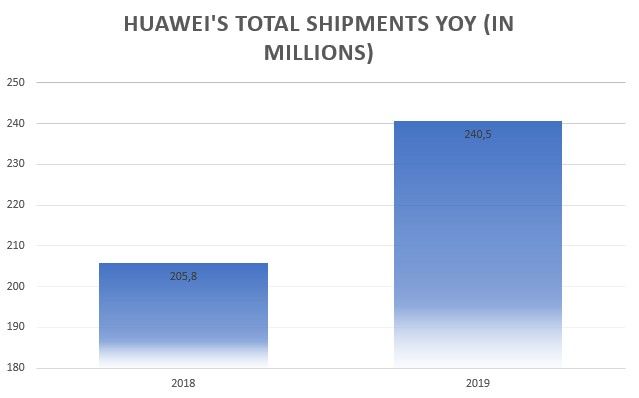
This is not to say that they didn’t have an effect, though. Huawei’s inability to bundle Google with their devices has left several of their key flagships, like the Mate 30 lineup and the Huawei Mate X, without a Western release at all. As such, global shipments dipped greatly, and so did global sales. They did surge as expected in China, though, so everything is going as well as they can go for Huawei in these circumstances. Given how Huawei is working on its own alternative to GMS called Huawei Mobile Services (HMS) and they even have an alternative OS in development, we might see Huawei launching their upcoming phones, such as the upcoming Huawei P40/P40 Pro, globally again in the short/long term, so these losses may perhaps turn around.

Samsung

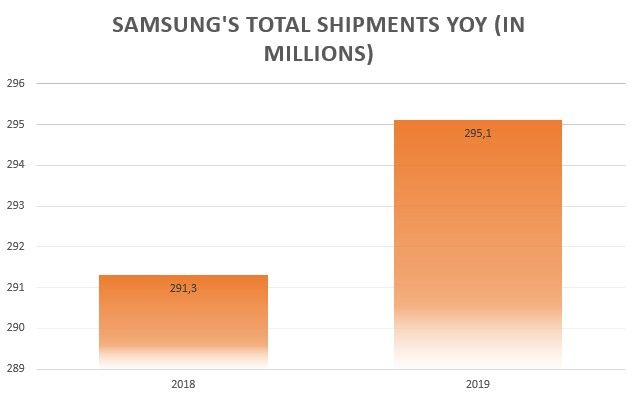
Samsung remains at the helm of the smartphone ecosystem. The Korean company had a pretty successful 2019 where they saw slightly better numbers than they did during 2018, which is impressive since they were already pretty good to begin with. With a 20.9% market share globally and over 295 million units shipped, they are still the uncontested champion of the smartphone ecosystem. Samsung did a lot of things right last year, including the highly successful S10 and Note 10 lineups as well as the revamped Galaxy A-line and the foldable Galaxy Fold.
2020 should see improvements in this strategy including the S20 lineup, the Note series successors which are expected for the end of the year, as well as the upcoming Galaxy Z Flip, a rumored Galaxy Fold 2 and the continuation of new Galaxy A phones such as the Galaxy A51 and the Galaxy A71. This should all translate to similar numbers for the end of this year, hopefully.

Apple

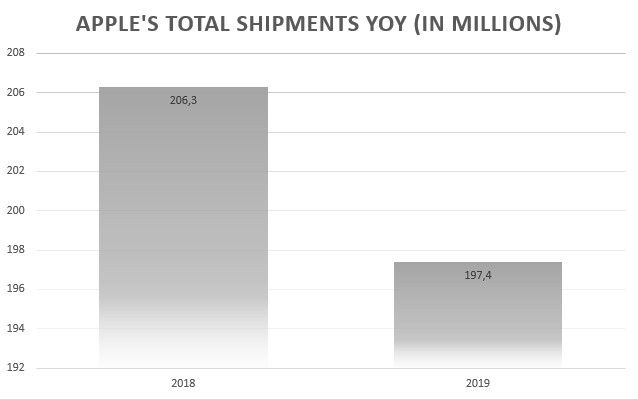
Apple was also a company that saw steady growth in 2019, although in overall sales numbers, they fell through the cracks compared to Huawei, falling down to being the third biggest smartphone manufacturer in the world. Apple’s strategy varies very little year-on-year, and their 2019 lineup was almost identical to their 2018 lineup: the iPhone 11 succeeded the iPhone XR, the iPhone 11 Pro succeeded the iPhone XS, and the iPhone 11 Pro Max succeeded the iPhone XS Max — the only major variation being the naming strategy. As for actual numbers, the company shipped around 197 million units last year, seizing a 14% market share.
There is one small stat where Apple has the edge over Samsung and Xiaomi, though, and it’s the fact that they were number one throughout Q4 2019, shipping over 70 million units globally, as Samsung and Huawei shipped 68 million and 56 million respectively. This accounts for 18.9% of all smartphone sales by the end of the year. So while Samsung and Huawei still lead Apple in overall YoY sales, Apple does have the edge on QoQ growth. This year should see similar numbers, although a rumored release of the iPhone SE2/iPhone 9 could also give Apple a heavy boost as the phone would cater to a lower price point and be more affordable.

Xiaomi

Xiaomi is still sitting comfortably at 4th place just like in 2018, but growth, while definitely nowhere near the levels of the other smartphone manufacturers, did exist. The company captured over 8.8% of Q4 2019 market share, up from 6.9% in Q4 2018, accounting for a 2% increase — keep in mind that we’re talking at the global scale and millions of phones, and this increase means that, during Q4 2019, they shipped 7 million more phones than they did in Q4 2018. 2019 was a big year for Xiaomi as they saw noteworthy events, like the separation of the Redmi lineup into a Xiaomi sub-brand and the release of flagship-grade devices such as the Xiaomi Mi 9 and the Redmi K20 Pro, as well as mid-rangers such as the Redmi Note 7, Note 7 Pro, Note 8, Note 8 Pro, and the Xiaomi Mi A3, so this growth makes sense.
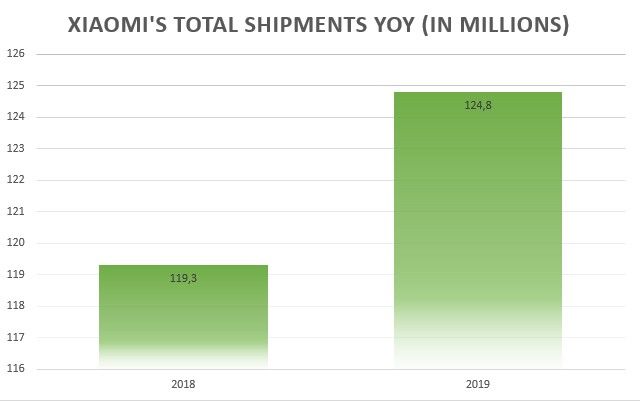
As Xiaomi further deepens and polishes this strategy, we fully expect these numbers to increase even more and more. We’ve already seen noteworthy events, such as their separation of POCO into an independent brand, take place this year, and we’re only 1 month into the year, so growth is fully expected going forward from now.


Source 1: Canalys / Source 2: Strategy Analytics / Source 3: Counterpoint Research / Source 4: Kantar

The post Huawei overtook Apple to become the 2nd largest smartphone brand in 2019 appeared first on xda-developers.


from xda-developers https://ift.tt/3aYNFWv
via IFTTT

jeudi 30 janvier 2020

ASUS rolls out the Android 10 update to the ZenFone Max Pro M1

Asus is updating its nearly two-year budget phone to Android 10. The Asus ZenFone Max Pro M1, which launched in April 2018, is now receiving an Android 10 Beta in India and France. For a budget phone that’s not part of the Android One program, getting two Android platform updates is indeed great news. However, as the device owners would recall, this wasn’t totally unexpected at all. At the time of launch, Asus had promised to deliver two major Android updates including Android Q to the ZenFone Max Pro M1. The device received the first promised update in the form of Android 9.0 Pie back in April last year. And keeping its promise, Asus is now rolling out the second and final update to the device.

Asus ZenFone Max Pro M1 XDA forum

The ZenFone Max Pro M1 update comes with version 17.2017.1911.407 and is 1.6GB in size. The Android 10 update brings along many exciting changes including a system-wide dark mode, full-screen navigation gestures, improved Digital Wellbeing tools with Focus Mode and parental controls, more control over app permissions, Live Captions and a whole lot more. You can learn more about all the new changes in Android 10 here.

You can sideload the Android 10 beta using the full OTA‌ zip given below. For those rocking custom ROMs, we also have a flashable ROM‌ zip that you can flash from TWRP. Installing a beta software requires a clean install so make sure to backup your data before you flash the update.

Download Android 10 beta for the Asus ZenFone Max Pro M1:

Full OTA package || TWRP flashable package

XDA Discussion Thread for the update

It’s unclear when the stable update will arrive but given the public beta is out now, we hopefully won’t have to wait for too long.


Thanks to XDA Member renda-l for the tip!

The post ASUS rolls out the Android 10 update to the ZenFone Max Pro M1 appeared first on xda-developers.


from xda-developers https://ift.tt/31cjabm
via IFTTT

Samsung opens up pre-order notifications for the Galaxy S20

Samsung typically allows customers to “reserve” their spot in line to purchase new devices. As the launch of the Galaxy S20 series approaches, Samsung has done just that. You can now sign up to be notified the instant the pre-orders open up for your preferred Galaxy S20 model.

To sign up, you will be asked to provide your first and last name, email address, and zip code. You will also be able to select your preferred carrier: unlocked, Verizon, AT&T, T-Mobile, Sprint, or US Cellular. Keep in mind that this isn’t truly a “reservation” to buy the device. It simply means you will be notified immediately when the Galaxy S20 pre-orders open, so be ready to put down some money.

Galaxy S20 Ultra XDA Forums ||| Galaxy S20+ XDA Forums ||| Galaxy S20 XDA Forums

One interesting tidbit of information from the reservation page: it says “Delivery by March 6.” That’s nearly a month after the Galaxy S20 devices will be announced at Unpacked, which is longer than Samsung’s typical wait period. We’re also expecting Samsung to reveal the Galaxy Z Flip at Unpacked, but that device will likely have a special pre-order process.

For those who haven’t been keeping up with the onslaught of news, we will be seeing the Galaxy S20, Galaxy S20+, and Galaxy S20 Ultra 5G. The Galaxy S20 and S20+ will have 5G variants. You can check out the full (rumored) specifications in the chart below.

Specification Galaxy S20/5G Galaxy S20+/5G Galaxy S20 Ultra 5G
System-on-chip Qualcomm Snapdragon 865/Exynos 990 Qualcomm Snapdragon 865/Exynos 990 Qualcomm Snapdragon 865/Exynos 990
Display
  • 6.2-inch Dynamic AMOLED
  • 3200×1440
  • 120Hz @ FHD+
  • 6.7-inch Dynamic AMOLED
  • 3200×1440
  • 120Hz @ FHD+
  • 6.92-inch Dynamic AMOLED
  • 3200×1440
  • 120Hz @ FHD+
Fingerprint scanner In-display Ultrasonic In-display Ultrasonic In-display Ultrasonic
Front camera
  • 10MP IMX 374
  • Video recording up to 4K 60fps
  • 10MP IMX 374
  • Video recording up to 4K 60fps
  • 40MP
  • Video recording up to 4K 60fps
Rear Camera
  • 12MP wide
  • 12MP ultra-wide
  • 64MP 3x Zoom
  • Video recording up to 8K 24fps
  •  12MP wide
  • 12MP ultra-wide
  • 64MP 3x Zoom
  • ToF
  • Video recording up to 8K 24fps
  • 108MP wide
  • 12MP ultra-wide
  • 48MP periscope telephoto: 10x optical zoom, 30x hybrid, 100x digital
  • ToF
  • Video recording up to 8K 24fps
RAM 12GB 12GB 12GB/16GB
Storage
  • 128GB/256GB UFS 3
  • Micro SD card slot
  • 128GB/256GB UFS 3
  • Micro SD card slot
  • 128GB/512GB UFS 3
  • Micro SD card slot
Battery Capacity 4,000 mAh 4,500 mAh 5,000 mAh
Water Resistance IP 68, 5 meters IP 68. 5 meters IP 68, 5 meters
Price ~$1000 ~$1100 ~$1300
Availability Rumored March 13th Rumored March 13th Rumored March 13th

Source: Samsung

The post Samsung opens up pre-order notifications for the Galaxy S20 appeared first on xda-developers.


from xda-developers https://ift.tt/36DKQ9R
via IFTTT

Android Auto app adds an option to disable notification sounds while driving

Android Auto allows you to integrate your smartphone with your car, with the driver’s safety of paramount importance. While it’s great for allowing you to control your music, have navigation guidance, get weather reports, and more whilst driving, it’s not unheard of that it can distract a driver. Until now, for example, every time you received a notification you would hear it through your car’s speakers. That’s obviously of great annoyance if you’re trying to focus on driving, especially if you get a lot of notifications. In version 5.0.500224 of the Android Auto app, though, there’s finally an option to switch the sound from notifications off.

android auto sound notifications

While this feature took a long time for Google to add, it’s not quite free of all distractions yet. Even when the sound is off, notifications will still show on your car’s screen until they are dismissed. According to some users, notifications are stuck on the screen even when the sound for notifications is switched on. Still, the feature is exactly what many had been requesting for a long time. No longer will your music be interrupted by an untimely notification, and nor should you be distracted by a constant binging of notifications while you’re driving if you don’t want that.

If you don’t have the feature yet, be sure to update to the latest version of the Android Auto application to give it a try. Hopefully, Google can fix the stuck notifications bug soon!

Android Auto - Google Maps, Media & Messaging (Free, Google Play) →


Source: /r/AndroidAuto

The post Android Auto app adds an option to disable notification sounds while driving appeared first on xda-developers.


from xda-developers https://ift.tt/2RGJpDG
via IFTTT

LG’s 2019 financial report reveals its mobile business is still struggling despite the company’s overall success

LG has long been one of the giants of the smartphone industry, and for the record, they are also one of the biggest companies in technology as of the current day. But recently, they have started to stall quite a bit when it comes to smartphones and Android-powered devices. As it stands, LG has lost a lot of its former market share and their devices have also started to dip in quality: their flagship smartphones are often rather lackluster and they’re no stranger to weird gimmicks, yet they keep failing to actually innovate, with most of its smartphone sales being relegated to low-end phones.

While LG as a company has been quite successful throughout 2019, its financial reports show that the smartphone division is still struggling. LG’s own graphics show a sharp drop in Q4 2019 compared to Q4 2018, which the company attributes to “sluggish sales in the overseas market with a sales decrease of mass-tier products in North America,” while the loss of profitability is attributed to a sales decline combined with an increase in marketing expenses.

Additionally, LG sees a prospective 2020 where they expect an increase in demand for premium products, partly thanks to growth of 5G demand as well as the release of various new form factors, likely alluding to LG possibly planning to release foldable phones competing with the likes of the Galaxy Fold and the upcoming Galaxy Z Flip. They also plan to amp up their pricing game as the slide alludes to an “offensive pricing policy.” It remains to be seen whether LG actually manages to pull this off, as the year is just beginning and LG is planning to launch new devices at MWC 2020.

LG clearly needs a change of strategy, as these numbers reveal. Whether what the company is planning to do to overturn these losses is actually enough, though, is a story for another day.


Source: LG

The post LG’s 2019 financial report reveals its mobile business is still struggling despite the company’s overall success appeared first on xda-developers.


from xda-developers https://ift.tt/2RDRclw
via IFTTT

[Update: ADT-3 On Sale] Google announces Android 10 for Android TV alongside a new ADT-3 developer device

Update (1/30/20 @ 12:45 PM ET): The ADT-3 Android TV device is now available to purchase for $79.

Android runs on over 2.5 billion devices around the world. Most of those devices are smartphones, but there are also millions of smartwatches, tablets, televisions, and set-top boxes. Android for TVs and STBs, also called Android TV, is much more tightly controlled by Google than Android for smartphones. Manufacturers of TVs and STBs, along with operators, aren’t allowed to make many modifications to the core Android TV experience, so what you see with each new release of Android TV is basically what you’ll get on any given device. Today, Google announced the Android 10 update for Android TV along with a new testing device for developers – the ADT-3.

Android 10 on Android TV

Google announced the stable Android 10 update for smartphones back in early September, but they held off on announcing the update for TVs. That’s because the Android version customized for TVs operates under a different release schedule. However, Android TV is still based on AOSP, so the move to a new OS version brings with it several under-the-hood changes that apply to both smartphones and TVs. Notably, Android 10’s new security and privacy features, such as the introduction of TLS 1.3, will help secure user data from malicious apps built for the platform. Project Mainline support will enable Google to serve updates to key framework components directly from the Play Store – bypassing the need for OEMs/operators to push an update. Features like Live Caption, currently a Pixel smartphone exclusive, could be implemented on TVs since the underlying API is part of the Android framework.

In the press release, Google didn’t note any Android TV-specific UX changes or new features, so this announcement may seem a bit underwhelming. I would argue that that’s a good thing, though. Thanks to reduced fragmentation, Android TV doesn’t need major OS upgrades to introduce new features and experiences, unlike on Android for smartphones. Developers can take advantage of Android 10’s new APIs by targeting API level 29 in their apps.

ADT-3 Developer Device

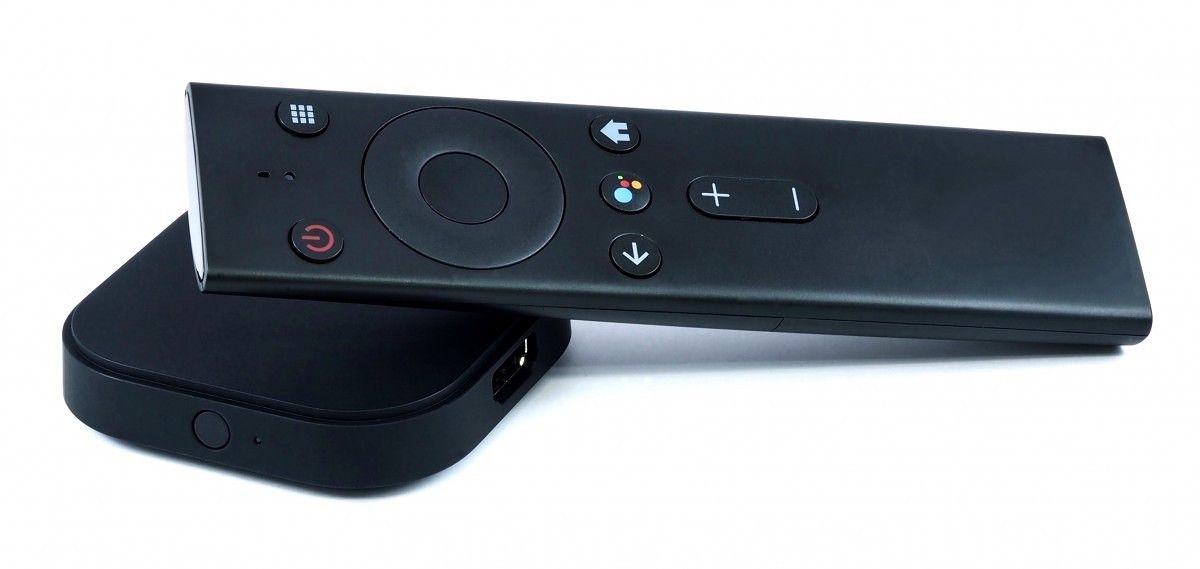
In order to properly develop for the platform, developers need a test device running the latest OS version. The ADT-2 was announced at Google I/O 2018 as a testbed for Android 9 Pie, and the new ADT-3 is, as you might expect, a testbed for the new Android 10 release. It’s a small set-top box with a quad-core A53 CPU, 2GB of DDR3 memory, and 4K60 HDR HDMI 2.1 video output. It’s been pre-certified to run Google apps and services, and it’s guaranteed to receive updates and security patches from Google. The device will be sold to interested developers through an OEM partner in the coming months.

ADT-3 running Android TV with Android 10


In mid-September, Google shared a preview of the Android 10 OS release (and their roadmap for the next two Android versions) at the annual International Broadcasting Convention (IBC). This presentation was given to TV/STB manufacturers, operators, and content providers, but it provides a nice overview of Google’s long-term plans for the platform. Google is clearly invested in the success of their TV business, though we wish the same could be said for their smartwatch ecosystem.


Update: ADT-3 On Sale

Google’s Android 10-based Android TV device for developers is now available to purchase. The device is being sold through Askey, which is a subsidiary of ASUS Computers. The ADT-3 is available in the US as well as Australia, Austria, Belgium, Canada, Czech, Denmark, Finland, France, Germany, Hong Kong, Hungary, India, Italy, Japan, Netherlands, New Zealand, Norway, Poland, Portugal, Romania, Singapore, South Korea, Spain, Switzerland, and the United Kingdom.

While there’s nothing stopping consumers from buying and using the ADT-3, the store listing says the device should “only be used by developers.” There are better options out there for consumers when you consider it’s $79 and an extra $15 for shipping.

Source: Askey (US), Askey (other regions)

The post [Update: ADT-3 On Sale] Google announces Android 10 for Android TV alongside a new ADT-3 developer device appeared first on xda-developers.


from xda-developers https://ift.tt/2RD98NB
via IFTTT