LightBlog

mardi 18 février 2020

Future Galaxy S20 update may enable 120Hz refresh rate at QHD+ resolution

High refresh rate displays are all rage nowadays. The feature that was once limited to gaming-oriented phones has been steadily trickling down to more mainstream devices lately. From the top-of-the-line flagship to the affordable mid-range, it’s quickly becoming commonplace. One of the latest phones to launch with a high refresh display is Samsung’s Galaxy S20 lineup which features a 120Hz panel across the range. But one drawback with a higher refresh rate is the increase in battery draw. In the case of the Galaxy S20 series, it also packs a QHD‌+ resolution display which combined with the high display refresh rate could potentially result in even higher battery consumption. To avoid excessive power consumption, Samsung chose to restrict the 120Hz high refresh rate to 1080p resolution only, and make it unavailable at QHD+.

XDA Forums: Samsung Galaxy S20 || Samsung Galaxy S20+ || Samsung Galaxy S20 Ultra

This could be a bummer for those wanting to experience the smoothness of 120Hz refresh rate in crisp QHD+ resolution. But it appears Samsung may address this concern in a future update. According to our own Max Weinbach, Samsung is currently in the process of optimizing software to enable a 120Hz refresh rate at QHD+ resolution and could release it to the Galaxy S20 series in the coming months if everything goes as intended.

Separately, Ice Universe has shared a screenshot of an in-development firmware build which suggests Samsung could allow users to select the 120Hz refresh rate at the maximum screen resolution. Samsung may be allowing this in response to strong user feedback. They may or may not have solved the underlying power consumption issues, though. Given how large the batteries are on the S20 series, though, we doubt users will have many problems.

Power consumption wouldn’t have been a concern if Samsung had used LTPO (low-temperature polycrystalline oxide) display technology which dynamically controls the refresh rate based on the user interaction. However, as per Ross Young from DSCC, the technology is still in its infancy and won’t be available for smartphones until later this year. The only devices on the market that uses LTPO are the Apple Watch Series 5 and Samsung’s Galaxy Watch Active 2.


Source: @UniverseIce; @MaxWinebach

The post Future Galaxy S20 update may enable 120Hz refresh rate at QHD+ resolution appeared first on xda-developers.


from xda-developers https://ift.tt/2HxV95k
via IFTTT

Xiaomi releases the Redmi K30 5G kernel source code

Late last year in December, Xiaomi launched the Redmi K30 and Redmi K30 5G in China. While the company hasn’t launched the devices internationally yet, its former sub-brand POCO launched the Redmi K30 as the POCO X2 earlier this month in India. In a bid to promote third-party development for the device, POCO also released its kernel source code at the launch event. POCO’s dev-friendly nature and its willingness to support the modding community is one of the main reasons behind the brand’s popularity. Now, it seems like Xiaomi is following in its footsteps and has released the kernel sources for the Redmi K30 5G, even before its launch in international markets.

Redmi K30 5G XDA Forums

The timely kernel source code release is expected to jumpstart development efforts for the mid-range 5G device from the company. Not only will it help power users improve the device’s performance by analyzing the code, but it will also help developers release custom ROMs and kernels for the device. If you’re planning on purchasing the device and are interested in pushing the device to its limits, you should head over to our Redmi K30 5G forums from the link above and keep a tab on the third-party development for the device. We expect to see some great custom ROMs and kernel releases for the device following the launch, which will help you make the most out of your new phone. If you’re a developer, on the other hand, you can access the kernel sources on GitHub from the link below and spearhead development for the device.

Redmi K30 5G Kernel Sources

The post Xiaomi releases the Redmi K30 5G kernel source code appeared first on xda-developers.


from xda-developers https://ift.tt/2SFXdP4
via IFTTT

Microsoft Your Phone brings RCS and cross-device copy and paste to Windows if you have the Galaxy S20 or Z Flip

 Microsoft has seemingly held a growing love for the Android platform in recent months, instigating a relationship with Samsung and integrating the company’s Your Phone app into Samsung smartphones. The premise is simple – link your Samsung smartphone to your computer and share notifications, make phone calls, and more between your phone and computer. The app was first launched alongside the Samsung Galaxy Note 10 but later made its way to other devices too. Now there are more exclusive Samsung features for the Galaxy S20 series and the Galaxy Z Flip – cross-device copy and paste, and RCS via Windows.

In the case of cross-device copy and paste as part of the Your Phone app, there’s no word as to whether or not that will always remain a Samsung exclusive, though it’s very likely to be. The support page for cross-device copy-paste is already live and it is available for Samsung Galaxy S20, Samsung Galaxy S20+, Samsung Galaxy S20 Ultra, and Samsung Galaxy Z Flip devices only. It’s likely to remain a Samsung exclusive for some time, as the clipboard can only be read in Android 10 if the app is the active foreground application.
The Your Phone app integrates with the Galaxy S20 series and Z Flip

As for RCS, that technology has had somewhat of a rocky history, though carriers are finally beginning to implement it. Through the Your Phone app on the Galaxy S20 series of smartphones, you’ll be able to send RCS messages from your PC through your phone, with no word on there being an exclusivity time period or not. The feature was announced by Roberto Bojorquez on Twitter, a group program manager at Microsoft. You’ll need to use the default Samsung Messages app though, and there’s no word on whether or not this will also be available for the Samsung Galaxy Z Flip. You can download the Your Phone app below.

Your Phone Companion - Link to Windows (Free, Google Play) →


Via: Android Police | Via 2: Android Police

The post Microsoft Your Phone brings RCS and cross-device copy and paste to Windows if you have the Galaxy S20 or Z Flip appeared first on xda-developers.


from xda-developers https://ift.tt/3bIHAhr
via IFTTT

Google Stadia adds support for the Samsung Galaxy S20, Razer Phone, ASUS ROG Phone, and more

Google’s game streaming service, Stadia, launched late last year. The service has received mixed reviews, but it’s still very early. Currently, Stadia is pretty limited as it only supports Pixel devices if you want to play on a phone. Thankfully, a bunch more devices, including the new Galaxy S20 series, are gaining support this week.

Of course, the Android community is a resourceful group, and there are methods to get Stadia working on non-Pixel phones. On Thursday (February 20th), Stadia will officially support the devices listed below. The list is mainly Samsung flagship devices from the last few years along with gaming phones from Razer and ASUS. The latter additions make a lot of sense and will be great devices for Stadia.

  • Samsung Galaxy S8
  • Samsung Galaxy S8+
  • Samsung Galaxy S8 Active
  • Samsung Galaxy Note 8
  • Samsung Galaxy S9
  • Samsung Galaxy S9+
  • Samsung Galaxy Note 9
  • Samsung Galaxy S10
  • Samsung Galaxy S10e
  • Samsung Galaxy S10+
  • Samsung Galaxy Note 10
  • Samsung Galaxy Note 10+
  • Samsung Galaxy S20
  • Samsung Galaxy S20+
  • Samsung Galaxy S20 Ultra
  • Razer Phone
  • Razer Phone 2
  • ASUS ROG Phone
  • ASUS ROG Phone II

The previous restrictions for mobile devices still remain. You can only play Stadia games through a Wi-Fi connection, so don’t plan on gaming with your new Galaxy S20 on the bus. Founder’s Edition, Premiere Edition, or a Buddy Pass is required as the free tier has not been released yet. This is an important step for the success of the platform. Pixel phones are not nearly as popular as Samsung Galaxy phones, so this opens Stadia up to a much larger pool of users.


Source: Stadia

The post Google Stadia adds support for the Samsung Galaxy S20, Razer Phone, ASUS ROG Phone, and more appeared first on xda-developers.


from xda-developers https://ift.tt/38PSWhT
via IFTTT

[Update: New Image] OPPO teases its smartwatch with a square design

Update (2/18/20 @ 10:50 AM ET): OPPO’s Brian Shen has shared another image of the upcoming OPPO Watch.

At last year’s OPPO Inno Day event in China, the company confirmed that it will be launching a variety of new products in Q1 2020. The company revealed that following the launch of the Reno3 and Reno3 Pro 5G, it will be bringing a new smartwatch, smart wireless headphones, a 5G hub, and AR glasses to the market. At the time, OPPO had been teasing a new smartwatch for a while and the company’s VP, Head of Research, Levin Liu, also confirmed that the upcoming OPPO smartwatch will be unveiled in Q1 2020. As expected, OPPO has now released the first teaser of the upcoming smartwatch which showcases its Apple-watch like square design.

OPPO smartwatch

The teaser in question was recently shared by OPPO’s VP Shen Yiren on Weibo, who now goes by the name ‘Confident eyebrows’ on the platform. The image showcases a square smartwatch with rounded corners and a slightly curved display. The watch has a gold-colored case with two buttons on the right edge and a cream-colored watchstrap. The design is undeniably inspired by the Apple Watch, much like the Xiaomi Mi Watch from last year, to the point that even the wallpaper in the teaser looks like something straight from the Apple’s collection.

As of now, OPPO has released no technical information about the upcoming smartwatch. However, the company did talk about having the “technological know-how” to enable eSIM support at the Inno Day event, which leads us to believe that the smartwatch will most likely feature eSIM support.

Source: Weibo


Update: New Image

The last teaser of the OPPO Watch showed off the square display with curved edges, two side buttons, gold finish, and the overall Apple Watch-like design. Today, Brian Shen has shared a new image of the watch, this time focusing on the curved screen and 3D glass. In the tweet, he claims it will be a “game changer.” Looking beyond the marketing-speak, however, there doesn’t appear to be anything unique about this design. The new image also appears to show a leather watchband, compared to the previous image that featured a silicone band. It’s hard to tell from the image, but this one looks to be silver.

The post [Update: New Image] OPPO teases its smartwatch with a square design appeared first on xda-developers.


from xda-developers https://ift.tt/316YCRx
via IFTTT

Save an Extra 15% on 1TB of Cloud Storage for President’s Day

Given that hard drives fail from time to time, backing up your files to the cloud is a smart move. However, the big names in the business make you pay a premium for cloud storage. If you are looking for a more affordable alternative, ThunderDrive Pro is definitely worth your attention. This platform offers secure storage at a price to suit any budget. This holiday weekend, you can get a lifetime 1TB subscription for just $33.15 when you use code PRESIDENT15 at the XDA Developers Depot.

You might not have heard of ThunderDrive, but this platform is a rising star. The service uses premier Tier IV data center facilities, with servers that run six times faster than Amazon’s. As a result, you can upload and access your files with impressive speed.

ThunderDrive Pro works on all major desktop and mobile operating systems, along with most browsers. You can easily upload files via the web interface, and your data is secured with 256-bit AES encryption.

Once your files are online, you can access them on all your devices. ThunderDrive also lets you share files with friends and colleagues using self-destructing links. 

Lifetime service on the Pro 1TB plan is worth $900, but you can get your subscription now for just $33.15 with the code PRESIDENT15 (ends 2/18).

 
ThunderDrive Pro (1TB): Lifetime Subscription – $33.15 with code

See Deal

Prices subject to change

The post Save an Extra 15% on 1TB of Cloud Storage for President’s Day appeared first on xda-developers.


from xda-developers https://ift.tt/3bQ0hj2
via IFTTT

Qualcomm announces the Snapdragon X60 modem for flagship 5G smartphones

Qualcomm has announced the Snapdragon X60 modem for flagship 5G phones. The news comes almost exactly a year after the announcement of its predecessor, the Snapdragon X55 modem. The Snapdragon X60 is the third-generation 5G modem-RF system from Qualcomm, succeeding the Snapdragon X55, which in turn succeeded the first-generation Snapdragon X50. The company has also announced the new ultraSAW RF filter technology. Let’s take a look at both of these announcements one-by-one:

Snapdragon X60 modem-RF system
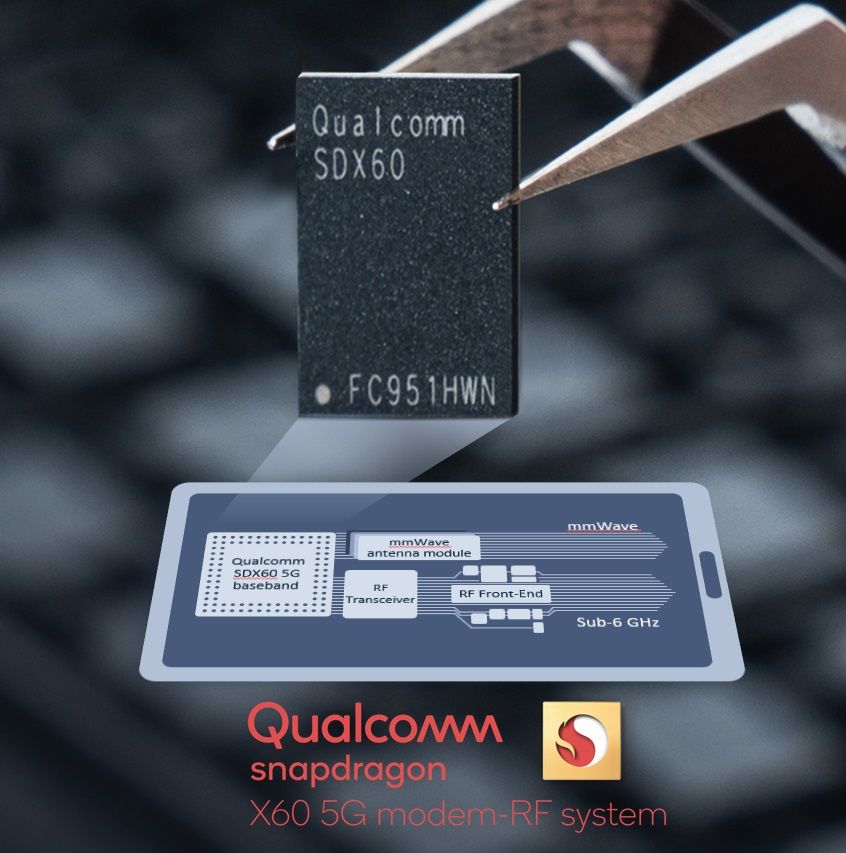
The Snapdragon X60 features the world’s first 5nm baseband. (Qualcomm didn’t state who will be manufacturing the X60, but given TSMC’s leadership in the 5nm process, it’s likely to be manufactured on TSMC’s 5nm FinFET process.) The 5nm process will lead to power efficiency gains in a smaller footprint.

The Snapdragon X60 is also the world’s first 5G modem-RF system to support spectrum aggregation across all key 5G bands and combinations, including millimeter wave (mmWave) and sub-6 (sub-6GHz 5G) using frequency division duplex (FDD) and time division duplex (TDD).

The system is engineered to accelerate network transition to 5G stand-alone mode through support for any key spectrum band, mode or combination. All 5G networks until now are using non-stand alone (NSA) mode, which means they require an LTE anchor for a 5G data link. 5G networks will soon transition to SA mode, however, which will allow them to be able to operate independently of LTE as the connection will be exclusively a 5G data link. The transition from NSA to SA will start in 2020 and continue in 2021.

The Snapdragon X60 features support for 5G Voice over NR (VoNR), which is the successor to VoLTE. It will allow users to make calls over 5G networks.

It also features the new Qualcomm QTM535 mmWave antenna module, which is the company’s third-generation 5G mmWave antenna module, succeeding the QTM525 and QTM052 modules. This module has support for the 26/28/39GHz bands that are being/will be used in mmWave 5G networks in North America, South Korea, Japan, and Europe. As a quick reminder, 5G smartphones incorporating mmWave need at least two of these antenna modules, in addition to the modem itself. This is because mmWave requires a line-of-sight to the node to maintain connection, and its signal is so poor that it can be blocked by buildings, trees, and even a user’s hand. It also doesn’t work indoors. Therefore, device makers place these modules in different orientations (one will be placed on the top while the second will be placed on the left/right hand sides) of the phone so that it’s not blocked by the user’s hand. The QTM535 features a more compact design than the previous generation (Qualcomm didn’t give specifics here), which will presumably lead to thinner phones.

The Snapdragon X60 allows for fiber-like Internet speeds and low latency, delivered wirelessly over 5G. Qualcomm hopes it will unlock the next generation of connected applications and experiences such as highly responsive multiplayer gaming, immersive 360-degree video and connected cloud computing. It will have “superior” power efficiency for “all-day battery life.”

Qualcomm Snapdragon X60 modemThe major new feature of the Snapdragon X60 is that it’s the world’s first to support mmWave-sub-6 aggregation, which should allow carriers to maximise their spectrum resources to combine capacity and coverage. With this aggregation, carriers can have their peak throughput surpass 5.5Gbps, according to Qualcomm. It’s also a way to have the best of both worlds as carriers can have both network coverage as well as capacity. Serious doubts remain on mmWave’s ability to function as an effective 5G mechanism, though, because of the aforementioned limitations of the technology. The optimal use case for mmWave will probably be for outdoor public places such as landmarks, while sub-6 5G will function as the effective successor of 4G LTE.

It also features the world’s first 5G FDD-TDD sub-6 carrier aggregation solution for double the speeds. This comes in addition to supporting 5G FDD-FDD and TDD-TDD carrier aggregation, along with dynamic spectrum sharing (DSS), which was introduced last year with the Snapdragon X55. DSS allows operators to deploy 5G services on low frequency FDD bands already in use for LTE, which is what T-Mobile is doing with its low-band “nationwide” 600MHz 5G network. The Snapdragon X60 gives carriers a wide range of deployment options such as being able to repurpose LTE spectrum for 5G to deliver higher average network speeds and accelerate 5G expansion.

Qualcomm says that with smartphones based on Snapdragon X60, operators can utilize a mix of frequency bands (mmWave, sub-6 GHz – including low bands), band types (5G FDD and TDD), and deployment modes (SA and NSA) to achieve an optimal combination of high-speed and low-latency network coverage.

The Snapdragon X60’s theoretical maximum downlink goes up to 7.5Gbps, while the maximum uplink stays at 3Gbps. In comparison, the Snapdragon X55’s theoretical maximum downlink is 7Gbps. Qualcomm says that the aggregation of sub-6GHz spectrum in SA mode allows the doubling of peak data rates in SA mode compared to solutions with no carrier aggregation support (i.e. the Snapdragon X55). Also, VoNR support will allow mobile operators to provide high-quality voice services on 5G NR.

In conclusion, Qualcomm says the Snapdragon X60 is the extension of a modem-to-antenna family that combines the baseband, transceiver, and complete RF-front-end for mmWave and sub-6GHz. The company is scheduled to ship samples of the Snapdragon X60 and QTM535 in the first quarter of 2020, with commercial premium phones using the new modem-RF system expected in early 2021. This means the modem-RF system will likely be paired with the next-generation Snapdragon flagship SoC, the Snapdragon 875. What we don’t know yet is whether the Snapdragon 875 will integrate this 5G modem on-chip like the Snapdragon 765, or whether it will remain a discrete modem like the Snapdragon 865. This piece of information will be revealed in December at the annual Tech Summit. Another piece of unknown information is whether the Snapdragon 865 supports the X60 modem.

The 5nm process also means the Snapdragon X60 is unlikely to ship on products this year. In 2019, the 7nm Snapdragon X55 did manage to ship on two Snapdragon 855-powered products: the 5G AT&T and T-Mobile variants of the Samsung Galaxy Note 10+ as well as the T-Mobile OnePlus 7T Pro 5G McLaren.

ultraSAW RF filter technology

Along with the Snapdragon X60, Qualcomm has also announced its ultraSAW RF filter technology. This is said to be another “groundbreaking innovation”. It’s said to significantly improve radio frequency performance in bands up to 2.7GHz, and it’s also said to outperform competing filter technologies at lower cost.

Radio frequency (RF) signals isolate radio signals from the different spectrum bands that phones use to receive and transmit information. According to Qualcomm, its ultraSAW filters achieve as much as 1 decibel (db) improvement in insertion loss, thereby offering a higher performance solution compared to competing bulk-acoustic (BAW) filters in the sub-2.7GHz frequency range.

Qualcomm’s ultraSAW technology is said to achieve superior filter characteristics to deliver high performance in frequencies from 600MHz to 2.7GHz with benefits including excellent transmit, receive and cross isolation; high frequency selectivity; a Q-factor of up to 5,000 – which Qualcomm says is significantly higher than the quality factor of competing BAW filters; very low insertion low; and excellent temperature stability with very low temperature drift in the single-digit ppm/Kelvin range. According to the company, all of this allows for more-efficient RF paths in 5G and 4G multi-mode devices at a lower cost point than competing commercial solutions with similar performance metrics for OEMs.

The ultraSAW technology serves as a key one behind the performance of Qualcomm’s radio frequency front-end (RFFE) product portfolio (which is under scrutiny by the European Commission) as well as its 5G modem-RF systems. The company is integrating this technology across its product line including PA modules, front-end modules, diversity modules, Wi-Fi extractors, GNSS extractors, and RF multipliers.

For consumers, Qualcomm says that improved RF performance will help device makers bring 5G devices with superior connectivity and battery life to consumers. A lineup of discrete and integrated Qualcomm ultraSAW products will begin production this quarter. Flagship devices from device makers are expected to be commercially available in the second half of 2020.

The post Qualcomm announces the Snapdragon X60 modem for flagship 5G smartphones appeared first on xda-developers.


from xda-developers https://ift.tt/2SYgp9C
via IFTTT
