LightBlog

mercredi 19 février 2020

Google Nest speakers will soon be able to intelligently adjust volume with Ambient IQ

Way back in October of 2019, Google announced a feature called “Ambient IQ.” This is not to be confused with Ambient EQ, but it is a similar concept. While Ambient EQ is about color temperature, Ambient IQ is all about volume. The feature looks to finally be on its way to the Google Nest speakers.

Ambient EQ intelligently adjusts the color temperature of the display on the Nest Hub, Nest Hub Max, and Pixel 4, based on the surrounding lighting conditions. Similarly, Ambient IQ can adjust the volume when outside noise interferes. For example, you may be listening to a podcast while getting dressed and your hairdryer drowns out the speaker. Rather than manually adjusting the volume yourself, Ambient IQ will do it for you.

One important thing to note is Ambient IQ is only for spoken audio content such as podcasts, audiobooks, and news. Music is not supported as Google says people enjoy music in a variety of ways, not always in the forefront. People like to use music as background noise, but spoken audio, such as a podcast, is usually listened to with more focus. The new support page for Ambient IQ lists the Nest Mini, Nest Hub, Nest Hub Max, and Nest Wifi as devices that can use the feature.

We’re not sure if this feature is rolling out right now or coming soon, but when it’s available you won’t have to do anything to make it work. I tested it on a Nest Mini and it didn’t seem to work yet. Do you think this is a useful feature for smart speakers?


Via: Android Police

The post Google Nest speakers will soon be able to intelligently adjust volume with Ambient IQ appeared first on xda-developers.


from xda-developers https://ift.tt/38H1uaL
via IFTTT

Firefox releases an Android app for its VPN service

Mozilla Corporation, the organization that is primarily known for developing the free and open-source Firefox web browser, has been slowly releasing its own paid VPN service, known as the Firefox Private Network VPN, for more than a year now. It was launched as a full-device paid VPN service for Windows users, and now, Mozilla has released an Android app for it. The service still requires a closed invite as the beta nature remains, and it costs $4.99 per month. This differentiates it from free VPN services packaged with browsers such as Opera VPN.

The Firefox Private Network VPN is powered by Mullvad VPN. Mullvad VPN claims that it won’t log and monitor user data, unlike many other VPN services. Mozilla’s rationale for making its VPN service a paid one is to ensure that it doesn’t profit from user data, while still managing to have a revenue source. Firefox VPN uses Mullvad VPN’s servers that are located in over 30 countries, and all traffic is encrypted and private. Up to five simultaneous connections are supported.

The Firefox Private Network uses the new WireGuard standard instead of offering traditional protocols such as OpenVPN or IPsec. For more details on WireGuard, check out our past coverage on the standard. WireGuard offers performance, power efficiency, and privacy benefits over protocols such as OpenVPN, but it’s not in a stable form as of yet. Most commercial and free VPNs, therefore, don’t support WireGuard as of now. This is the primary differentiating factor for the Firefox Private Network.

Firefox’s VPN currently costs $4.99 per month, which sounds quite steep, but competing services that have the same functionality actually have similar prices. It also only works in the US for now, as Mozilla says expansion to other regions is coming later. It also notes that this is “limited-time beta pricing.” This note doesn’t make much sense as users are still asked to ask for an invite for a paid beta service, which is quite strange. Regardless, users can try their luck by downloading the Android app for the service.

Firefox Private Network VPN (Free, Google Play) →


Via: Android Police

The post Firefox releases an Android app for its VPN service appeared first on xda-developers.


from xda-developers https://ift.tt/3bOMGsp
via IFTTT

Storage Redirect is a root app that isolates storage access for bad Android apps

If you have ever browsed through the file directory of your phone, you probably would have noticed a huge pile of dormant folders and files that essentially serve no value. Many apps don’t follow the best practices and leave behind a large number of files after you uninstall them from your phone. To give users more control over their storage and limit app clutter, Google introduced Scoped Storage access in Android 10, which restricts how apps can access the external storage. While implementing Scoped Storage isn’t mandatory for apps targeting Android 10, Google will fully implement this new change in the next major release: Android 11. 

But you don’t have to wait for Android 11 to take control of your device storage. Storage Redirect is an app that works on the same principle as Scoped Storage and lets you manage how apps use your storage. With Storage Redirect, you can choose which apps you want to isolate and which apps you want to give full access to the shared storage. Once an app is isolated, it can only access files from within its own directory and files generated by the app will also remain in the isolated storage. 

Here’s what you can do with Storage Redirect: 

  • You can control which of your private files the app can use (by folder)
  • Files created by the app will remain in isolated storage
  • Isolated storage will be automatically deleted after uninstalling the app
  • You can create your own rules to decide which important files to “synchronize” from the isolated storage to the shared storage space

Storage Redirect requires root access to perform its magic so make sure you meet this requirement before giving it a try.

Storage Isolation (Storage Redirect) (root) (Free+, Google Play) →

The post Storage Redirect is a root app that isolates storage access for bad Android apps appeared first on xda-developers.


from xda-developers https://ift.tt/3bUQwjY
via IFTTT

The Emperion Nebulus could be the first smartphone running Windows 10 on ARM

Windows on smartphones ended up meeting a terrible fate. It started out strong with Windows Mobile in the year 2000, launching as “Pocket PC 2000.” It was the OS of choice for PDAs and other mobile devices before being superseded by Windows Phone, a proper Windows-based competitor to iOS and Android. Windows Phone was yet again superseded by Windows 10 Mobile in 2015 in an attempt to streamline Microsoft’s software experience across platforms. Unfortunately, though, it ended up meeting its terrible fate soon after as iOS and Android both outdid Microsoft’s operating system in market dominance. But for a company called Emperion, the Windows dream may not be over yet.

The company took to Twitter to tease the Emperion Nebulus, a smartphone that runs Windows 10 on ARM—not Windows 10 Mobile, which is effectively dead and gone as of a month ago, but rather the full-fledged Windows 10 operating system for ARM-based SoCs. Windows 10 on ARM aims to provide the same features and reliability we have on x86 and x64-based systems right now, but it is not optimized for phones nor is it meant to be used in a mobile device. It’s not even able to make phone calls as-is which, to be honest, defeats the point of a phone.

It will have Emperion’s own UI on top which we’re guessing will help with the task of optimizing it for a phone. The phone is also, oddly, touted to be able to run Android apps without requiring to switch to another operating system. We’re not quite sure how that would work given that Android and Windows 10 are both wildly different beasts and Emperion also says that it doesn’t involve emulation, so we shall see.

In a similar fashion to Continuum on Windows 10 Mobile, the Emperion Nebulus will be able to switch to a desktop mode with USB-C or wireless, and it is likely that it will roll out into a full-fledged desktop experience since it’s already running full Windows 10—so far so good here. The device is using an overclocked Snapdragon 845 processor which is an odd choice in 2020 given how there’s already a Snapdragon 865 out that’s two generations older, but it may also point to the fact that it’s probably been in development for quite a while. Windows 10 on ARM laptops often had either the Snapdragon 850 or the Snapdragon 8cx which are both made for laptops specifically.

Overall, though, it seems like a pretty interesting device. Windows 10 on ARM has been booted a couple of times on Android phones, but it’s often nothing more than a cool experiment as, again, it’s not an operating system that is adapted to phones.


Via: Windows Central

The post The Emperion Nebulus could be the first smartphone running Windows 10 on ARM appeared first on xda-developers.


from xda-developers https://ift.tt/2P5woBy
via IFTTT

Facebook is testing tabbed News Feed with Most Recent, Most Relevant, and Already Seen options

Facebook has long been at the helm of social media. With over 2.5 billion monthly active users, which accounts for roughly a third of the world’s population, it is huge in numbers. And as a company, they also own other apps and social networks such as Instagram and WhatsApp, both of which are also huge in their own right. Given this huge userbase, a big chunk of which are mobile users, it goes unmentioned that the company puts a lot of care to their Facebook app’s experience, even though it’s been often regarded as “bloated.” Nonetheless, they do, and the app is now getting new features to make feed exploring more comfortable.

The Facebook app is testing a new tabbed News Feed with options for sorting based on post visibility. Now, you’ll be able to sort posts based on Most Recent, Most Relevant, and Already Seen. Most Recent sorts posts in chronological order, Most Relevant is the current default we all see, and Already Seen shows posts we’ve already seen appear in our news feed, possibly in a chronological mode. These new sorting options should be pretty useful for allowing us to sort our news feed however we want.

Have in mind that this feature, as of the time of writing, is currently not live: it is just something Facebook is testing internally. Nonetheless, once it goes live once and for all, it will probably first come to users through A/B testing, like most Facebook features–including its recent UI/UX redesign–have rolled out for the past few years. If you don’t have the Facebook app on your phone and want to try out this feature eventually, though, then it would be a good idea to pull ahead and download the app to your phone right now.

Facebook (Free+, Google Play) →

The post Facebook is testing tabbed News Feed with Most Recent, Most Relevant, and Already Seen options appeared first on xda-developers.


from xda-developers https://ift.tt/2ucp1kF
via IFTTT

Motorola says it has “full confidence” in the durability of the Razr’s foldable display

The Motorola Razr’s launch has been a difficult one. It was announced in November, attracting a lot of hype because of its vertically folding flip phone nature. Motorola even had to delay the phone’s release for a month because of increased demand. As soon as it went in the hands of reviewers, however, harsh realities began to emerge. The Razr’s foldable display lasted 27,000 folds in CNET’s FoldBot test, below the officially rated 100,000 figure. Motorola had to clarify that bumps and lumps on the foldable display were “normal” as it used a special hinge mechanism to avoid the crease. As its foldable display was plastic, scratching it was much easier than scratching a traditional glass display. The hinge mechanism also made a creaky sound. Most reviewers were critical of the overall experience that the Razr provided. Durability concerns went up a notch when InputMag’s Razr unit’s display spontaneously started breaking after a week of use, as its screen lamination was peeling off. The publication’s Raymond Wong speculated that this could have been due to the phone being quickly shifted from cold ambient outdoor weather to a heated room.

This kind of negative publicity isn’t what Motorola had in mind. The company did show innovation for being the first to market with a vertically folding flip foldable phone, but that’s not good enough. It still remains confident about the Razr’s display, though. In an official response to InputMag, Motorola said that it has “full confidence” in the Razr’s display, and it does not expect consumers to experience display peeling as a result of normal use. As part of its development process, the Razr underwent “extreme temperature testing”, but as with any mobile phone, the company recommends not storing the phone in temperatures below 4 degrees F and above 140 degrees F. Any device failure related to weather during normal use and not as a result of abuse or misuse will be covered under the company’s standard warranty.

InputMag notes that the problem doesn’t seem to be widespread at this point, but this is probably due to the very small quantity of devices being in market. Mashable’s tech reporter has reported that whenever cold air comes in, the display on her Razr unit is crunching every time when it is folded and unfolded. A Samsung Galaxy Z Flip user also speculated that his brand new foldable phone’s display broke out of the box after flipping it due to cold weather, as he heard it crack after opening it in cold ambient temperature. Samsung immediately replaced that unit, but the reason for the breakage is still unknown.

The Motorola Razr is not the first foldable phone on the market to face durability issues. The Samsung Galaxy Fold’s recall and redesign saga is well known. The Galaxy Z Flip’s Ultra Thin Glass behaves like regular plastic and not like glass when it comes to durability, as it can be scratched very easily, even with a fingernail. The Huawei Mate X never saw an international release after the US trade ban (it remains a unicorn), but its outer folding nature led to durability concerns from the beginning. It’s clear there is still quite a long way to go before foldable phones achieve maturity when it comes to how durable they are in comparison to regular slate phones.

The Motorola Razr is available exclusively from Verizon in the US for $1,400. (Strangely, it uses only an eSIM and not a nano SIM slot.) A gold color variant may launch soon. Motorola is also planning to launch the device in India in the near future.


Source: InputMag

The post Motorola says it has “full confidence” in the durability of the Razr’s foldable display appeared first on xda-developers.


from xda-developers https://ift.tt/37FDSBV
via IFTTT

[Update: Launched in India] Samsung Galaxy A71 launches with punch hole display and 64MP quad rear camera

Update 1 (02/19/2020 @ 04:00 AM ET): Samsung has launched the Galaxy A71 in India. Scroll to the bottom for more information. The article as published on December 12, 2019, is preserved as below.

It was only a couple of weeks ago when we got our first glimpse of the Samsung Galaxy A71 in leaked renders. Today, the company officially, but quietly, unveiled the device alongside the Galaxy A51. This is one of the most attractive devices we’ve seen so far in Samsung’s popular A-series. The Galaxy A71 offers some premium features for what we assume will be a reasonable price. Let’s take a look.

Specifications Samsung Galaxy A71
Display 6.7-inch, Full HD+ (1080 x2400)
Super AMOLED
Infinity-O Display
Camera
  • Main: 64MP, F1.8
  • Depth: 5MP, F2.2
  • Macro: 5MP, F2.4
  • Ultra-wide : 12MP, F2.2
Front Selfie: 32MP, F2.2
Body 163.6 x 76.0 x 7.7mm
179g
Processor Octa-Core (Dual 2.2GHz + Hexa 1.8GHz)
Memory 6/8 GB RAM
128GB Internal Storage
Micro SD slot (up to 512 GB)
SIM Card Dual SIM (3 slot)
Battery 4,500 mAh
25W Super-Fast Charging
Security On-Screen Fingerprint
Face Recognition
Color Prism Crush Black / Silver/ Blue / Pink

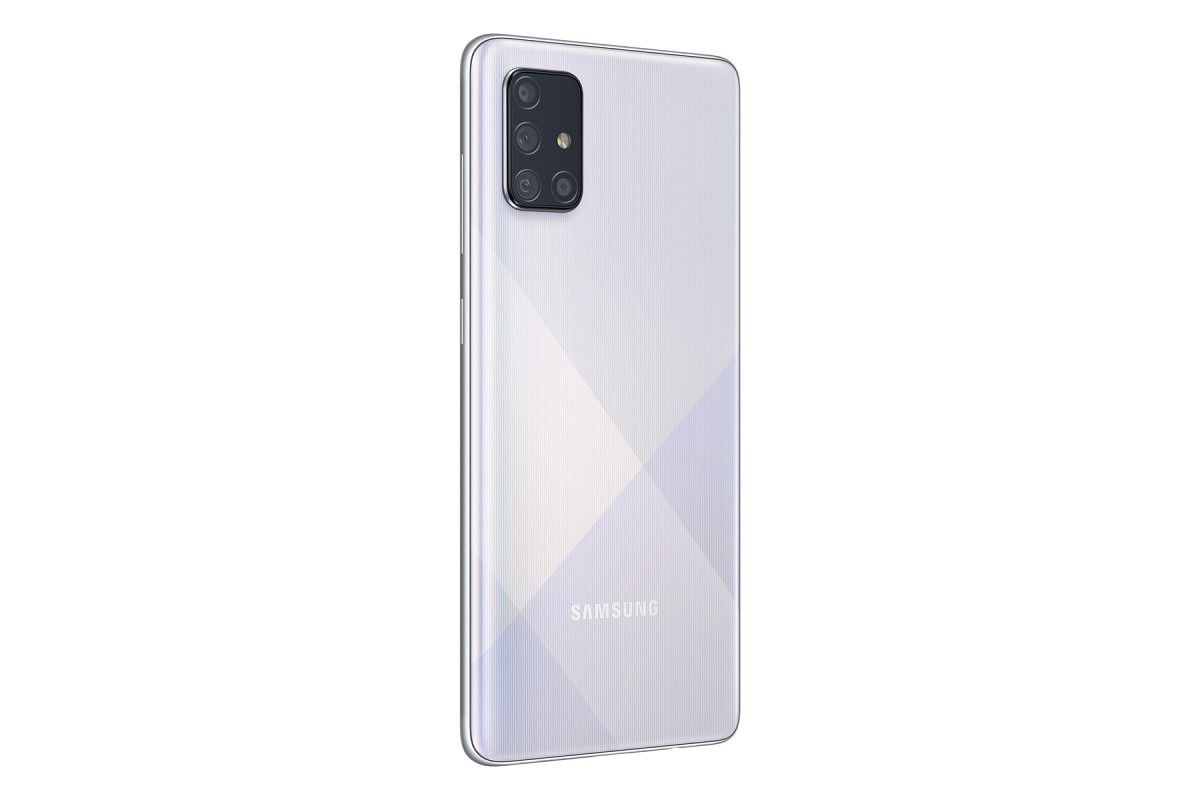
The Galaxy A71 falls in line with the new design that Samsung has been showcasing with the A-series. It has a single, centered hole-punch on the front and quad cameras on the rear in a big rectangular bunch. The back of the device also features a gradient cross-hatch pattern in four different color options: Black, Silver, Blue, and Pink.

The quad cameras start with the 64MP main shooter with f/1.8 aperture. Next up is the 12MP ultra-wide camera at f/2.2. We round things out with dual 5MP cameras, one being a depth sensor and the other a macro lens. Combined with the 32MP front camera, there are plenty of megapixels to go around.

Samsung Galaxy A71 Samsung Galaxy A71 Samsung Galaxy A71 Samsung Galaxy A71

Moving to the front, the Galaxy A71 has a 6.7-inch Full HD+ Super AMOLED display with the aforementioned “Infinity-O” punch-hole. The bezels around the display are very thin and nearly the same on all sides (the bottom chin is slightly thicker). There is also an in-display fingerprint sensor present here.

Let’s talk about power. The Galaxy A71 is equipped with an unnamed octa-core dual 2.2GHz + 1.8GHz processor, 6/8 GB of RAM, and 128 GB of storage. The processor is likely the Qualcomm Snapdragon 730. Battery life should be good as it’s packing a 4,500 mAh battery. Lastly, the A71 should ship with One UI 2.0 on top of Android 10.

Unfortunately, Samsung did not share when the Galaxy A71 will be available for purchase or how much it will cost. The Galaxy A70 was a very affordable device and we expect the A71 to be similar.

Source: Samsung | Via: SamMobile


Update: Samsung Galaxy A71 launched in India for ₹29,999 ($420)

Samsung has launched the Galaxy A71 in India for a price of ₹29,999 ($420) for the 8GB/128GB variant. Interested customers can pick up the phone in Prism Crush Silver, Blue, and Black colors, starting from February 24, 2020 across online and offline stores in the country.

Samsung Galaxy A71 — Hands-On

The post [Update: Launched in India] Samsung Galaxy A71 launches with punch hole display and 64MP quad rear camera appeared first on xda-developers.


from xda-developers https://ift.tt/2E8Cbk2
via IFTTT