LightBlog

jeudi 16 avril 2020

Huawei announces the Next-Image 2020 photography competition with prizes including a Huawei P40 Pro and up to $10,000

Huawei is among the leading pioneers of smartphone photography and it has proved this time and again with its P Series. Despite the hurdles due to the executive order passed by the U.S. President last year, Huawei has been launching new flagship phones, although in select markets. It launched the Huawei P40, P40 Pro, and the P40 Pro+ last month with a horde of exciting camera features which make it a desirable phone for many photography enthusiasts. Huawei is now hosting a global photography competition and the winners will win a Huawei P40 Pro and cash prizes up to $10,000.

Huawei is inviting “uplifting and inspirational” photographs and videos under its NEXT-IMAGE 2020 contest. There are over 70 prizes to be won in the content and participants can submit their photos or videos under six categories, such as:

  • Near Far – bringing different perspective in the same image
  • Good Night – focussing on nocturnal or low light ambiance
  • Hello, Life! – images focussing on human connections or emotions
  • Faces – portrait shots
  • Live Moments – short videos or movies with up to 10 minutes in length
  • Storyteller – telling a story using a series of 3-9 photographs

There are a few conditions for the contest and the first one is that only images and videos captured on a Huawei or an Honor phone will qualify for the competition. The window for submissions is open till midnight of July 31st (UTC+8 i.e. Beijing Time) and you can head over to the microsite to submit your entries or read up on the terms and conditions further.

Top photographers and Huawei executives will be deciding the winners. There will be three overall winners and each of them will get the $10,000 cash along with a Huawei P40 Pro (8GB/256GB). Among other prizes, there is the Huawei P40 Pro with a $1,000 cash prize for up to 15 top submissions, just the P40 Pro for as many as 50 runner-ups and five additional for honorable mentions.

The post Huawei announces the Next-Image 2020 photography competition with prizes including a Huawei P40 Pro and up to $10,000 appeared first on xda-developers.


from xda-developers https://ift.tt/3bgA6Bx
via IFTTT

OPPO Find X2 series and Reno3 Pro are OPPO’s first Android Enterprise Recommended smartphones

Google launched the Android Enterprise Recommended program back in 2018 to certify devices for enterprise deployment. With the program, Googled wanted to make it easy for businesses to easily determine which Android devices were best for them and the company certified devices based on a couple of different criteria. AER certified devices were required to meet a minimum hardware specification, support bulk deployment with zero-touch enrollment, get Android security updates within 90 days of release from Google for a period of 3 years, be available unlocked from the manufacturer or reseller, and more. As of now, Google has certified more than 150 devices from a variety of different manufacturers and the latest additions come from Chinese OEM OPPO.

OPPO smartphones have previously never met AER requirements, but this year, the company has enrolled 3 of its devices into the program: the OPPO Reno3 Pro (global variant), OPPO Find X2, and OPPO Find X2 Pro. The company has also set up a web page for its AER devices, where it highlights some of the features it will offer to enterprise users. These include regular security updates for 3 years from initial shipping and at least one Android version upgrade, flexible device management, zero-touch enrollment, and more.

Out of the three devices to make the cut, the OPPO Find X2 series offers flagship specifications, including Qualcomm’s Snapdragon 865 SoC, high refresh rate QHD+ displays, 12GB of LPDDR5 RAM, and impressive triple-camera setups. On the other hand, the OPPO Reno3 Pro is a mid-range device powered by MediaTek’s Helio P95 chip, coupled with 8GB of RAM, an FHD+ display, and a respectable quad-camera setup. It’s also worth noting that OPPO isn’t the only new company that is offering Android Enterprise Recommended devices this year. In a recent post on its forums, OPPO’s sister company OnePlus revealed that it also aims to have AER devices available this year. However, as of now, we have no information regarding the release timeline for OnePlus’ AER certified devices.


Source: Android Enterprise Solutions Directory (1,2,3)

The post OPPO Find X2 series and Reno3 Pro are OPPO’s first Android Enterprise Recommended smartphones appeared first on xda-developers.


from xda-developers https://ift.tt/2XH5LbA
via IFTTT

[Update: Live] Niantic considers adding options to explore and raid from home in Pokémon GO

Update 1 (04/16/2020 @ 05:12 AM ET): Remote raiding features are now live on Pokémon GO. Scroll to the bottom for more information. The article as published on March 31, 2020, is preserved below.

Pokémon GO began its journey in July 2016, building upon Niantic’s Ingress and the infrastructure the game put in place. Much like Ingress, Pokémon GO focused on exploring real-world locations to play the game. The initial response to the game was historic, as it fundamentally changed how geolocation-based games, as well as AR-based genres, are experienced by the public. While the focus has always been to go outside, there may be many reasons why someone cannot go outside — which is why we saw a great increase in activity on our threads that discussed location spoofing. Niantic clamped down on the idea of playing the game without moving, and one of the first steps it took was to block rooted devices (usually a pre-requisite for location-spoofing) from entering the game, and more recently, check aggressively for even hints of root or modifications. Now, COVID-19 health advisories have enforced the ideas of social distancing and staying indoors. Consequently, Niantic is being forced to rethink how players enjoy its geolocation and community-focused games in such difficult times. The company is now considering allowing players to explore areas and do Raid Battles with other players from the comfort of their homes.

In an announcement post titled “Embracing real-world gaming from home”, Niantic, Inc. has shared its product roadmap with a focus on enabling more ways for players to play its portfolio of games from inside their homes, in the coming weeks. Pokémon GO’s Adventure Sync feature will get improvements that will make it work even better with indoor movement and activities. The game will also see an enhancement on “in-game virtual social features” that will enable players to stay in touch when they can’t meet in real life (though this could be hinting at a Discord collaboration). The post further goes on to say that “you’ll soon be able to team up with friends and take on Raid Battles together in Pokémon GO from the comfort of home“, and “we’re also looking into how we can help players virtually visit and share memories about their favorite real-world places until they can once again visit them in person“.

Do these changes mean that Pokémon GO will officially provide a way to spoof your location? We don’t really know since the wording is up for interpretation. The announcement explicitly confirms the upcoming ability to participate in Raid Battles together — which is needed because 4-star and 5-star Raid Battles cannot be successfully completed by a single player, by design. Raid Battles occurred at Gyms on the map, which corresponded to a physical location in real life. So there will be some form of location manipulation feature at play here. However, you may not necessarily be able to virtually run around the world and catch Pokémon as one could through location spoofing apps.

Current screenshot from Pokémon GO. A Raid Battle is underway at the Gym, but one needs to physically reach there to participate. Similarly, one needs to physically reach Pokéstops to receive in-game items.

Curiously, Pokémon GO showed a very strong week-over-week growth of 67% for the week beginning on March 16. The game grossed $23 Million in gross revenue in the week, accounting for 13% of all total revenue earned in 2020 for the game. Downloads also spiked, with 1.6 million first-time installs over the week of March 9.

Report by SensorTower (via Gamesindustry.biz)

Despite the increase in activity and revenue, COVID-19 has forced Niantic to rethink its gameplay, and one can hope that the company has finally realized that moving around may not be a feasible option for many — COVID-19 or otherwise. Niantic did make changes earlier that made it easier to play the game indoors, such as introducing a new GO Battle League for PvP battles across the world, reducing walking requirements in-game, and deeply discounting in-game items to make it easier for players to play the game without needing to move out too much. Harry Potter: Wizards Unite and Ingress also received similar tweaks, offering an alternative gameplay style when community-play is not entirely possible. These changes are, however, temporary, as Niantic does mention that it will return back to its original vision once the pandemic has passed. We hope Niantic receives enough positive feedback to consider making some of these changes permanent.


Update: Remote Raiding arrives on Pokémon GO

Niantic has unveiled the new Remote Raiding features that are now live on Pokémon GO, allowing players to enjoy the game from their homes. The list of changes is as below:

  • With a Remote Raid Pass, you can access Raid Battles you can see on the Nearby screen from wherever you are.
  • You’ll receive a bonus Field Research task daily without having to spin a PokéStop.
  • As you run low on Gifts, your Buddy Pokémon will venture to nearby PokéStops and bring some Gifts back for you to send out to your friends.
  • You’ll be able to power up your Pokémon to the desired CP by using all the required Candies and Stardust at once.
  • After using a Star Piece, Lucky Egg, or Incense, you’ll be able to use more of the same item to extend the item’s effect beyond the usual 30-minute limit. No more waiting for an item effect to expire before you can use another one!
  • Look out for other updates, including improved battle-screen design.

Remote Raiding is currently restricted to the Gyms you can see on your screen, so you are still restricted to your immediate locality. Players can raid remotely by using a new item called Remote Raid Pass, and there can be only a few remote raiders in every raid battle party. Right now, remote raiders will have the same attack power as location raiders, but in the future, Niantic will lower the attack power for remote raiders so as to disincentivize this in favor of the original “go-outside” playstyle.


Pokémon GO (Free+, Google Play) →

The post [Update: Live] Niantic considers adding options to explore and raid from home in Pokémon GO appeared first on xda-developers.


from xda-developers https://ift.tt/2QYRNh3
via IFTTT

OnePlus 8, Samsung Galaxy A51 5G, and Samsung Galaxy A71 5G now support Google Play Services for AR

Google Play Services for AR (formerly Google ARCore) is a software service from the company that enables applications to create augmented reality experiences on devices without the need for dedicated hardware. While the service just uses a device’s existing cameras and sensors for the AR experience, Google has to work with OEMs to create custom calibration profiles for each device in order to ensure that the AR features work properly. The company regularly keeps adding to the list of support devices, and since our last coverage earlier this month, six more devices have gained official support for the service.

The following devices now officially support Google Play Services for AR:

  • Infinix Mobile Note 7
  • OnePlus 8
  • OnePlus 8 Pro
  • Samsung Galaxy A51
  • Samsung Galaxy A51 5G
  • Samsung Galaxy A71 5G

Once Google announces support for a new device, Google Play Services for AR is automatically pushed to the device and you can start using AR applications right away. However, in case you haven’t received the update yet, you can force it by sideloading the APK yourself. Once you have it installed on your device, you can start using any app or feature that offers AR capabilities. If you’re new to the AR realm, we’d recommend checking out Google’s Measure app that lets you take accurate measurements of objects around you or Pokémon GO’s AR+ mode for a more immersive Pokémon catching experience.

It’s also worth noting that while you can sideload the Google Play Services for AR APK on an unsupported device, you might face occasional glitches due to the lack of proper calibration. So make sure you check the full list of supported devices before sideloading the APK onto your phone.

Google Play Services for AR (Free, Google Play) →

The post OnePlus 8, Samsung Galaxy A51 5G, and Samsung Galaxy A71 5G now support Google Play Services for AR appeared first on xda-developers.


from xda-developers https://ift.tt/2XElLLf
via IFTTT

Firefox Preview for Android adds support for Dark Reader, NoScript, and 3 other add-ons

Google Chrome comes pre-installed on Android phones which is why it’s position as the most used mobile browser remains unshaken. But if you move out of the comfort zone and look for alternatives, you find quite a few substitutes for Chrome – and one of them is Mozilla Firefox. Back in 2018, Mozilla decided to stop adding new features to the stable version of the browser in favor of an overhauled version, which will be called Fenix. Fenix is currently in its testing phase and is available on the Google Play Store as Firefox Preview, which is now getting support for five new add-on services.

If you’re guessing the add-ons for Firefox have the same meaning with respect to the mobile version as the desktop variant, you’re right. In February this year, Mozilla introduced add-on support in Firefox Preview but only supported a single add-on which was Block Origin, a popular ad and content blocker.

Earlier this week, i.e. on April 14th, Mozilla announced that they’ll be adding five more popular add-ons to the Firefox Preview. The list includes:

  • Dark Reader – The add-on activates a dark theme on all pages by inverting colors and switching to a high contrast profile for easier reading at night. You can also adjust the brightness, contrast, add a night or sepia filter, and blacklist websites that need to be retained as original.
  • NoScript – This a security add-on that restricts other executable content to fend off attacks and vulnerabilities.
  • HTTPS Everywhere – Automatically switches from HTTP to HTTPS wherever the new protocol is supported
  • Privacy Badger – It prevents invisible trackers from overriding your preferences or inbuilt blockers in the browser.
  • Search by Image – Lets you reverse search images on a multitude of search engines and photo sharing websites.

To enable these add-ons, you need to hit the three-dot button alongside the address bar, tap on Settings, and then scroll down to Add-ons. Here you can enable the supported options as preferred. Remember, Firefox Preview is still in beta so there might be some inconsistencies in the way it performs.

Firefox Preview (Free, Google Play) →

The post Firefox Preview for Android adds support for Dark Reader, NoScript, and 3 other add-ons appeared first on xda-developers.


from xda-developers https://ift.tt/3eqLVal
via IFTTT

Google Phone app rolls out Call Recording for some Nokia phone users in India

The Google Phone app is the default dialer on Google’s Pixel devices, Xiaomi phones sold in the EU, and Android One phones like HMD Global’s Nokia-branded smartphones. Much like other stock apps from the company, it doesn’t offer as many features as other default dialer apps from companies like Xiaomi. This means that Xiaomi users in the EU currently don’t have access to features like automatic call recording and flip to silence which are available on the stock MIUI dialer in other regions. Over the last couple of months, however, Google has been working to add new features to its dialer app in an effort to bring it to the same level as some of its competition.

Earlier this year in January, an APK teardown of Google Phone v43 surfaced evidence which suggested that Google was working on a call recording feature for the app. With the rollout of Google Phone v44 later that month, we were able to fully activate the feature to show exactly how it would work upon release. It seems like the feature is finally ready for prime time, as it’s now rolling out to some Nokia phones in India. According to a recent post on the official Nokia community forums, a Nokia 7 Plus user has already received the feature on their device. The user initially believed that they only got the feature because they were connected to a VPN server in the U.S, but we’ve now seen reports from users on Telegram that other Nokia 7.2, Nokia 8.1, and Nokia 7 Plus users in India have also received the feature.

As of now, the feature is only available for a small subset of Nokia users in the country and it’s unclear whether an app update or server-side config change triggered the feature. Furthermore, it’s worth noting that Google is also working to add the flip to silence feature in the Google Phone app. The feature was recently spotted in an APK teardown of Google Phone v47, along with a new feature that will allow users to answer calls with 1-way video.


Thanks to Telegram users @AniEthanHunt for the tip!

The post Google Phone app rolls out Call Recording for some Nokia phone users in India appeared first on xda-developers.


from xda-developers https://ift.tt/3bf4E6C
via IFTTT

mercredi 15 avril 2020

Google Play Store is getting a Kid section with “Teacher Approved” Apps

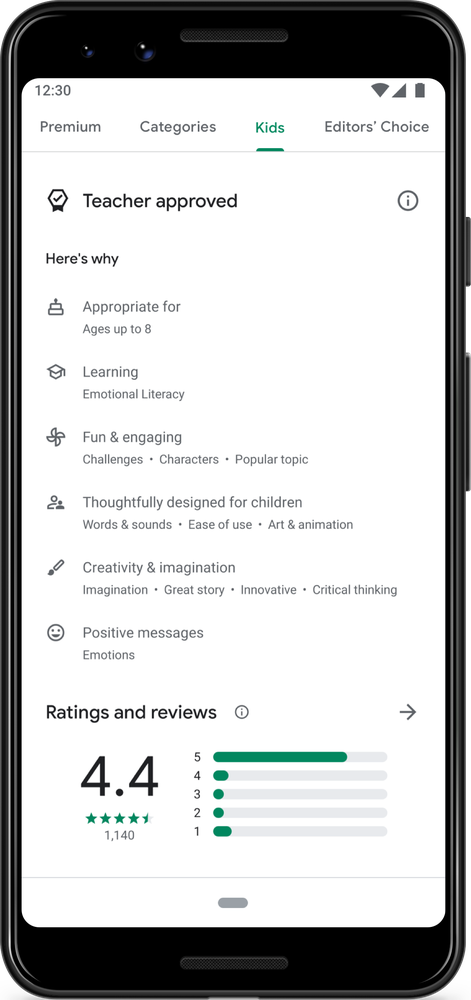
Any parent will tell you that managing screen time is a big concern when you have kids. The amount of time kids can spend in front of screens is one issue, but even more important is what is shown on the screen. Now, more than ever, parents are relying on managing screen time for their kids to cope with stay-at-home orders. It can be difficult to find apps and games that are appropriate and educational. The Google Play Store will make this easier with a new Kids tab and a “teacher approved” label.

Google has teamed up with academic experts and teachers across the US to rate kid-friendly content on the Play Store. Apps are rated on a number of factors, including age-appropriateness, quality of experience, enrichment, and delight. You’ll see this information on the app page listed under the “Teacher approved” label with descriptions for why the app is approved.

The Kids tab will be replacing the existing Family tab in the Google Play Store. Once this change is rolled out, there will be a “Teacher approved” section that curates these apps. If you’re a Google Play Pass subscriber, the selection is available within “Apps and games for kids.” These new features will be rolling out in the US over the next few days, and Google will be expanding to more regions in the “coming months.”


Source: Google

The post Google Play Store is getting a Kid section with “Teacher Approved” Apps appeared first on xda-developers.


from xda-developers https://ift.tt/2yYIbwo
via IFTTT