LightBlog

jeudi 3 septembre 2020

Google Chrome for Android adds Secure DNS for safer, more private browsing

With the release of Chrome 83 earlier this year in May, Google introduced a new Secure DNS feature to the desktop version of the browser. The feature made use of DNS-over-HTTPS to encrypt a step known as ‘DNS (Domain Name System) lookup’ to ensure a safer and more private browsing experience for users. Now, the company has started rolling out Google Chrome 85, which brings the feature to Android devices.

According to a recent blog post from Google, Chrome 85 brings support for Secure DNS in Chrome for Android and it shares the same design principles as the desktop variant. With the feature, Chrome will automatically switch to DNS-over-HTTPS (DoH) if your current DNS provider supports the feature. The automatic mode will ensure that Chrome can fall back to the regular DNS service offered by the user’s current provider (including DNS-over-TLS if configured) to ensure that users don’t face any disruptions, while periodically retrying to secure the DNS communication.

In case the default behavior isn’t suitable for users, Google Chrome will also give users a manual configuration option that will let them use a specific provider without a fallback. Additionally, users will get the ability to completely disable the feature from the browser settings.

Google Chrome 85 Secure DNS Android

The blog post further adds that Chrome will disable Secure DNS automatically “if it detects a managed environment via the presence of one or more enterprise policies.” Google has also added DNS-over-HTTPS enterprise policies “to allow for a managed configuration of Secure DNS and encourage IT administrators to look into deploying DNS-over-HTTPS for their users.” As with the desktop version, Secure DNS for Chrome on Android will roll out to users over a period of time to ensure stability and performance. The gradual rollout will also “help DoH providers scale their services accordingly.”

It’s also worth noting that since Google received some pushback from ISPs because of the DNS-over-HTTPs protocol last year, the company has added that it will “remain open to feedback and collaboration with interested parties such as mobile operators and other ISPs, DNS service providers, and Online Child Safety advocates to make further progress in securing DNS.”


Source: Chromium blog

The post Google Chrome for Android adds Secure DNS for safer, more private browsing appeared first on xda-developers.


from xda-developers https://ift.tt/3hVEd9A
via IFTTT

Realme 7 and Realme 7 Pro with up to 65W SuperDart Charge launched in India

Realme has tasted varying degrees of success in the smartphone markets of China, India, Southeast Asia, and even Europe. The brand entered the market just about 2 years ago with the Realme 1. Since then, the company has gone on to launch several phones in quick succession across several markets. The Realme 6 and Realme 6 Pro were launched just back in March 2020, and half a year later, we have their successors. Meet the new Realme 7 and Realme 7 Pro, two smartphones that share very few similarities other than their name family.

Realme 7: Specifications

Specification Realme 7
Dimensions & Weight
  • 162.3 x 75.4 x 9.4 mm
  • 197g
Display
  • 6.5″ FHD+ IPS LCD
  • 90Hz refresh rate
  • 120Hz touch sampling rate
  • Gorilla Glass 3
  • Punch-hole camera
SoC MediaTek Helio G95
  • 2x Cortex-A76 @ 2.05GHz
  • 6x Cortex-A55 @ 2GHz

ARM Mali-G76 MC4 GPU

RAM & Storage
  • 6GB LPDDR4x + 64GB UFS 2.1
  • 8GB + 128GB
  • Dedicated microSD card slot
Battery & Charging
  • 5000 mAh battery
  • Supports 30W Dart Charge
  • Supports 15W USB Power Delivery
  • 30W charger included in the box
Fingerprint sensor Side-mounted fingerprint scanner
Rear Camera
  • Primary: 64MP Sony IMX682, 1/1.73″ sensor, f/1.8
  • Secondary: 8MP, ultra-wide-angle, f/2.3, 119° FoV
  • Tertiary: 2MP, monochrome depth sensor, f/2.4
  • Quarternary: 2MP, macro, f/2.4

Video:

  • 4K @ 30fps
  • 1080p @30fps, 60fps
Front Camera 16MP, f/2.0
Other Features
  • Wi-Fi 2.4/5GHz 802.11 a/b/g/n/ac
  • Bluetooth 5.0
Android Version Realme UI based on Android 10

The biggest change on the Realme 7 as against the Realme 6 is the upgrade in the SoC, along with a bigger battery, and the swap in for the Sony IMX682 sensor.

The Realme 7 is the first smartphone with the new MediaTek Helio G95 SoC. The specifications for the SoC indicate that it is very similar to the Helio G90T, but the predecessor is a pretty decent SoC, so no real complaints here. Realme did bump up the base RAM, though the RAM tech, and storage variants and tech remain the same across the half-yearly upgrade.

The other change is the battery. We now get a 5000 mAh battery as opposed to the 4300 mAh battery on the Realme 6. The predecessor also supported 30W fast charging through the proprietary charger, and so does this one, promising a full charge in 65 minutes.

Pricing and Availability

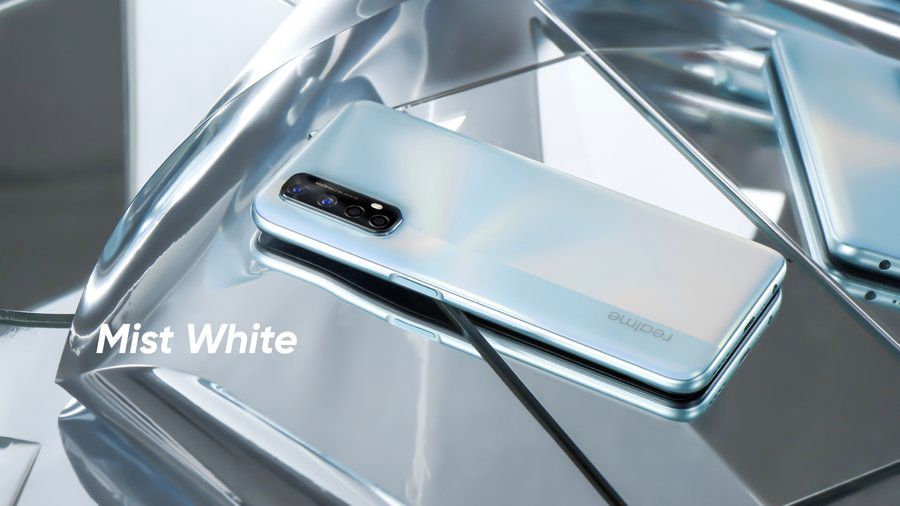
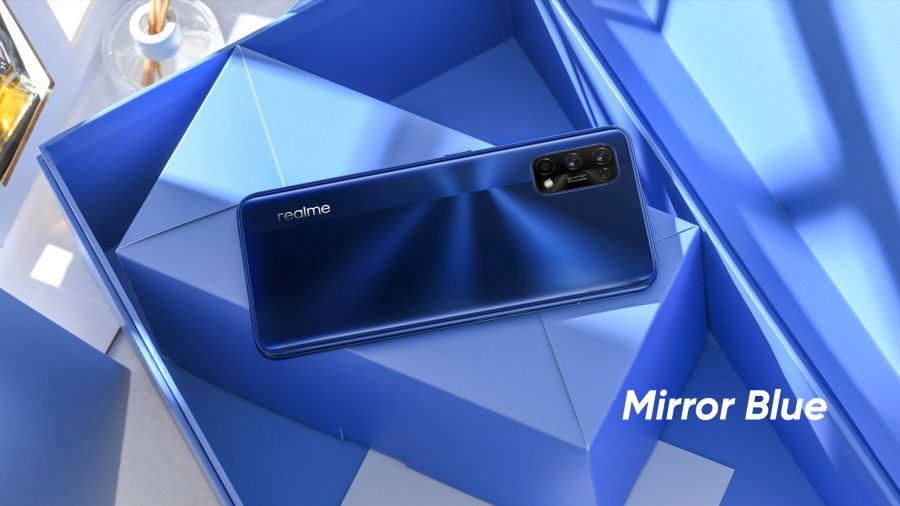
The Realme 7 will be available in two colors: Mist White and Mist Blue.

Realme 7 - Mist White Realme 7 - Mist Blue

The phone will cost ₹14,999 for the 6GB + 64GB variant and ₹16,999 for the 8GB + 128GB variant. Sales begin from September 10 on Flipkart.com and Realme.com.


Realme 7 Pro: Specifications

Specification Realme 7 Pro
Dimensions & Weight
  • 160.9 x 74.3 x 8.7 mm
  • 182g
Display
  • 6.4″ FHD+ Super AMOLED display
  • 180Hz touch sampling rate
  • Punch-hole camera
SoC Qualcomm Snapdragon 720G SoC
  • 2 x Cortex-A76 @ 2.3GHz
  • 6 x Cortex-A55 @ 1.8GHz

Adreno 618 GPU

RAM & Storage
  • 6GB LPDDR4x + 128GB UFS 2.1
  • 8GB + 256GB
  • Dedicated microSD card slot
Battery & Charging
  • 4500 mAh battery
  • Supports 65W SuperDart Charge
  • Supports 18W USB Power Delivery
  • 65W charger included in the box
Fingerprint sensor In-Display fingerprint sensor
Rear Camera
  • Primary: 64MP Sony IMX682, 1/1.73″ sensor, f/1.8
  • Secondary: 8MP, ultra-wide-angle, f/2.3, 119° FoV
  • Tertiary: 2MP, monochrome depth sensor, f/2.4
  • Quarternary: 2MP, macro, f/2.4

Video:

  • 4K @ 30fps
  • 1080p @30fps, 60fps
  • 1080p @ 120fps
  • 720p @ 240fps
Front Camera 32MP, f/2.5
Other Features
  • Wi-Fi 2.4/5GHz 802.11 a/b/g/n/ac
  • Bluetooth 5.0
Android Version Realme UI based on Android 10

A lot has changed on the Realme 7 Pro, as compared to the Realme 6 Pro. First and foremost, you now get a Super AMOLED, though Realme has curiously shrunk down the size of the display. The refresh rate for the new display is indeed 60Hz — which is a step down from 90Hz refresh rate on the Realme 6 Pro’s LCD display.

The SoC, RAM, and storage tech remains the same as the Realme 6 Pro, though we no longer have a 64GB storage option and get to see a 256GB option. Much like the Realme 7, the 7 Pro also swaps in the Sony IMX682 sensor for its main camera. The front camera also sees an upgrade to a 32MP shooter this time.

By far the biggest change on the Realme 7 Pro is that the phone now comes with 65W SuperDart charge, which makes it the cheapest phone in the market to feature such high-speed charging technology that we have predominantly seen on flagships. The battery is only marginally bigger at 4,300 mAh, but it now takes just under 35 minutes for a full charge and just 12 minutes for a 50% charge. We had the opportunity to use the phone, so we’ll put Realme’s claims to the test in our upcoming review.

Pricing and Availability

The Realme 7 Pro will be available in two colors: Mirror White and Mirror Blue.

Realme 7 Pro - Mirror Silver Realme 7 Pro - Mirror Blue

The phone will cost ₹19,999 for the 6GB + 128GB variant and ₹21,999 for the 8GB + 256GB variant. Sales begin from September 14 on Flipkart.com and Realme.com.

The post Realme 7 and Realme 7 Pro with up to 65W SuperDart Charge launched in India appeared first on xda-developers.


from xda-developers https://ift.tt/2Dq1u4v
via IFTTT

Qualcomm is bringing 5G to budget smartphones with new Snapdragon 4-series chips

5G connectivity is finally seeing mainstream adoption in 2020 as more and more smartphones and mobile SoCs add support for the next generation of telecommunications technology. The push for 5G has been very widespread in recent months, although some key markets may not have consumer 5G ready until next year. Nonetheless, that hasn’t stopped chip makers from pushing the envelope forward with bringing 5G down to lower tiers. Now, Qualcomm has announced its plans to bring 5G to even wider segments of users, promising new Snapdragon 4-series chips with 5G support in early 2021.

Today’s announcement from Qualcomm is bereft of a fair few details. While we can expect the modem to be integrated like on Qualcomm’s current 7 and 6-series 5G chips, we don’t know the supported bands, the theoretical download and upload speeds, the sub-6GHz bandwidth, and whether or not the modem will support mmWave 5G and/or standalone (SA) 5G. There are also other specs and features to be aware of, such as whether or not the chipset supports Dynamic Spectrum Sharing (DSS), 5G dual SIM dual standby (DSDS), and Qualcomm’s proprietary 5G PowerSave, Smart Transmit, Wideband Envelope Tracking, and Signal Boost adaptive antenna tuning technologies. Whatever they do announce, though, heralds hope for a wider proliferation of 5G. Qualcomm’s promise of 5G connectivity support on its upcoming Snapdragon 4-series chips will bring 5G support to budget and lower mid-range smartphones across the globe.

Qualcomm continues to pave the way for 5G commercialization at scale, and the expansion of 5G into our Snapdragon 4-series is expected to address regions that currently have approximately 3.5 billion smartphone users combined. The Snapdragon 4-series 5G Mobile Platform is designed to exceed expectations for the mass-market segment by bringing an assortment of predominately high- and mid-tier features to a broader audience. It will deliver on the promise of making 5G accessible to all smartphone users.

Cristiano Amon, President, Qualcomm Incorporated

Qualcomm’s current 5G-capable chipsets include the Snapdragon 855, 855 Plus, 865, 865 Plus, 765, 765G, 768G, and 690, with the 765, 765G, 768G, and 690 featuring integrated 5G modems. As is made apparent, there is a lack of 5G-capable chipsets on the lower end of Qualcomm’s chip portfolio. Qualcomm mentions that the expansion of 5G support to the Snapdragon 4-series will address regions where budget smartphones dominate, which includes approximately 3.5 billion users across the world. Not everyone may be ready to jump aboard right when new phones with the SoC arrive, but this would certainly shape the forthcoming months and years of smartphone evolution.

Qualcomm Snapdragon 4-series 5G

Smartphones with the 5G Snapdragon 4-series are expected to arrive from OPPO, Motorola, and Xiaomi, but we suspect many other OEMs to also jump on board sooner or later. The first batch of smartphones with the 5G Snapdragon 4-series is expected to arrive in Q1 2021.

The post Qualcomm is bringing 5G to budget smartphones with new Snapdragon 4-series chips appeared first on xda-developers.


from xda-developers https://ift.tt/31UkPEs
via IFTTT

Qualcomm’s Adaptive ANC aims to make noise cancellation better on TWS earbuds regardless of fit

Noise Cancellation on truly wireless earbuds is fast gaining steam, thanks to several key launches like the Apple Airpods Pro, the Sony WF-1000XM3, and the Samsung Galaxy Buds Live. But part of the active noise cancellation (ANC) game on these earbuds relies on noise isolation too, i.e. forming a tight enough seal in the ear. The Galaxy Buds Live fails to achieve good noise isolation, which is why its ANC hasn’t garnered as many rave reviews as the Sony WF-1000XM3’s have. Qualcomm wants to solve some of these issues, which is why they are now launching a new audio technology called the Qualcomm Adaptive Active Noise Cancellation, aimed at OEMs wanting to deliver a superior noise cancellation performance on their TWS earbuds without relying as heavily on the fit of the earbuds.

For most of the current-generation ANC earbuds available in the market, the effectiveness of noise cancellation depends heavily on forming a tight earbud seal in a user’s ear. Qualcomm’s Adaptive ANC solves this issue as it’s designed to deliver a consistent sound quality and noise cancellation performance regardless of the fit or seal created by the earbuds. Adaptive ANC will dynamically adapt its performance as per the tightness of the earbuds’ seal and the level of leak through.

It can sometimes be difficult for OEMs to deliver consistent ANC performance because earbuds will not always have the same fit or be placed in the ear in the same way, and both how and where a consumer uses these devices can vary greatly. We have designed our Adaptive ANC to help customers deliver consistent performance levels and great sound for the largest possible number of consumers.”

James Chapman, Vice President and General Manager, Voice, Music, & Wearables, Qualcomm Technologies, Inc

Another claimed benefit of Adaptive ANC is that it will seamlessly work across all modes. In other words, it’ll continue to provide noise cancellation as you switch from taking a call, to listening to music, to using a voice assistant without any interruption. Adaptive ANC can also offer automatic adjustments based on your surroundings, so it can increase the ANC strength when you’re in noisier environments or dial it down a notch when it detects quieter surroundings.

OEMs can use the Qualcomm Reference Design solution to quickly integrate the Adaptive ANC solution into their product. For those who want more differentiation, Qualcomm also provides an API to let OEMs further customize the solution to their liking and offer a unique experience. On top of that, OEMs will also have the choice to pick between different form factors, including fully occluded, semi-occluded, and non-occluded earbuds.

Adaptive ANC is available right now on as an add-on solution on Qualcomm’s QCC514x Bluetooth Audio SoC.

The post Qualcomm’s Adaptive ANC aims to make noise cancellation better on TWS earbuds regardless of fit appeared first on xda-developers.


from xda-developers https://ift.tt/34Vl83E
via IFTTT

Qualcomm announces the Snapdragon 8cx Gen 2 for “Always On, Always Connected” 5G PCs

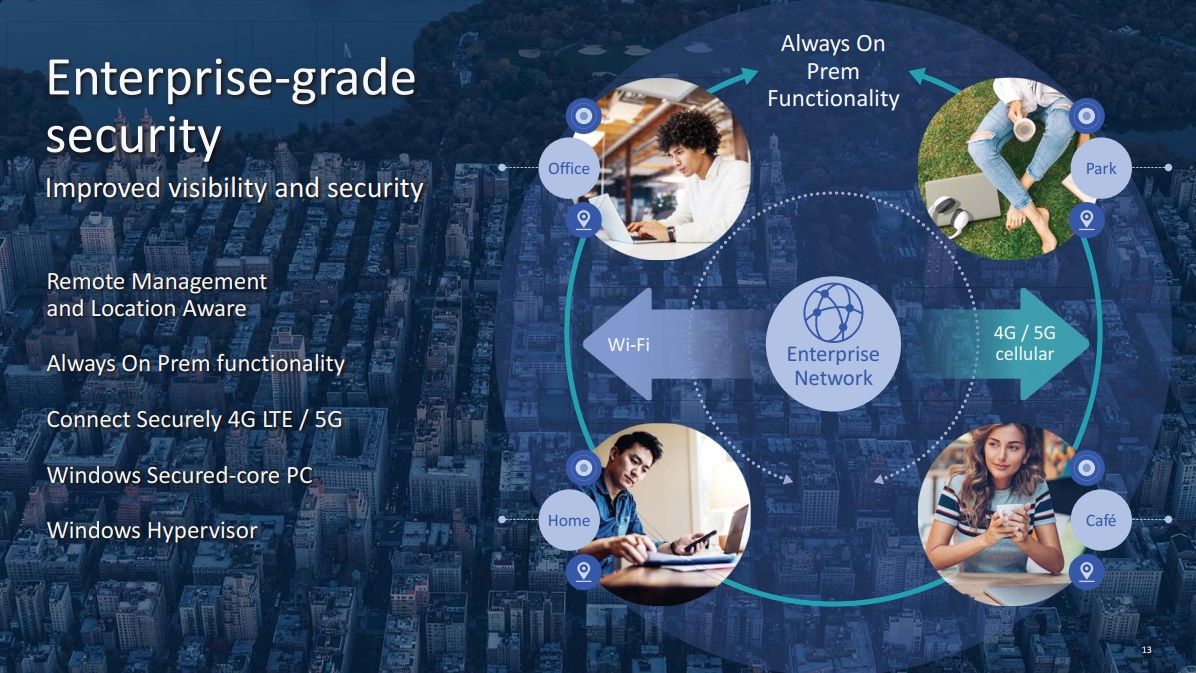
In 2018, Qualcomm announced the Snapdragon 8cx compute platform, the company’s highest-end chipset aimed not at smartphones or tablets but rather laptops. The Snapdragon 8cx was actually Qualcomm’s third attempt at designing a chip for consumer PCs, following the Snapdragon 835 and Snapdragon 850. In conjunction with Microsoft, Qualcomm has been working to create a new class of ultraportable laptops called the “Always On, Always Connected” PC; these “ACPCs”, powered by either the 835, 850, or 8cx compute platforms, are extremely thin and light, generally fanless, support cellular connectivity, and feature all-day battery life—hence “Always On, Always Connected.” Today, Qualcomm unveiled the second-generation of its Snapdragon 8cx compute platform for next-gen ACPCs.

The new chip is called the “Qualcomm Snapdragon 8cx Gen 2 5G compute platform,” which is certainly a mouthful. Qualcomm is labeling this product as “Gen 2” since it’s a minor update over the original platform and doesn’t feature any changes to the architecture. That means it still features an octa-core CPU in a 4+4 cluster configuration, with 4 ARM Cortex-A76 cores joined by 4 ARM Cortex-A55 cores. The GPU is Qualcomm’s Adreno 680 “Extreme”, which is still the company’s most powerful GPU to date. Other components and features include the Qualcomm 685 DSP and Qualcomm’s 4th generation AI Engine for 9 TOPS performance; the Qualcomm Spectra 390 ISP with support for 4K HDR playback or video capture at 30fps, a single 32MP camera with Zero Shutter Lag (ZSL), or dual 16MP cameras with ZSL; up to 4K on-device display resolution; dual 4K60 external monitor support; Qualcomm Aqstic echo-cancellation and noise suppression support; Hi-Fi audio with virtual surround sound support; full hypervisor and Windows 10 Enterprise support, and more.

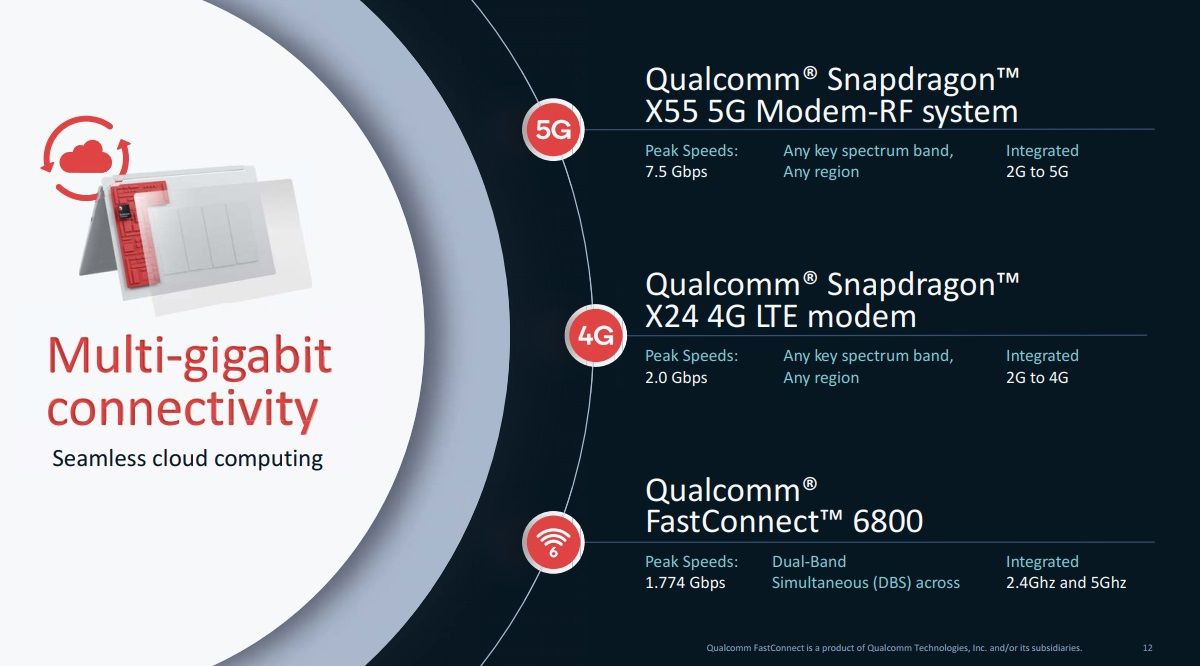
What’s actually new in the second-generation Snapdragon 8cx? Well, the platform now supports Qualcomm’s FastConnect 6800 mobile connectivity subsystem, which brings in support for Wi-Fi 6 (IEEE 802.11ax) and Bluetooth 5.1. Of course, the platform also still supports cellular connectivity with its integrated Snapdragon X24 modem which supports 4G LTE, but it can also optionally support 5G NR (both sub-6GHz or mmWave) if it’s paired with the discrete Snapdragon X55 modem-RF system.

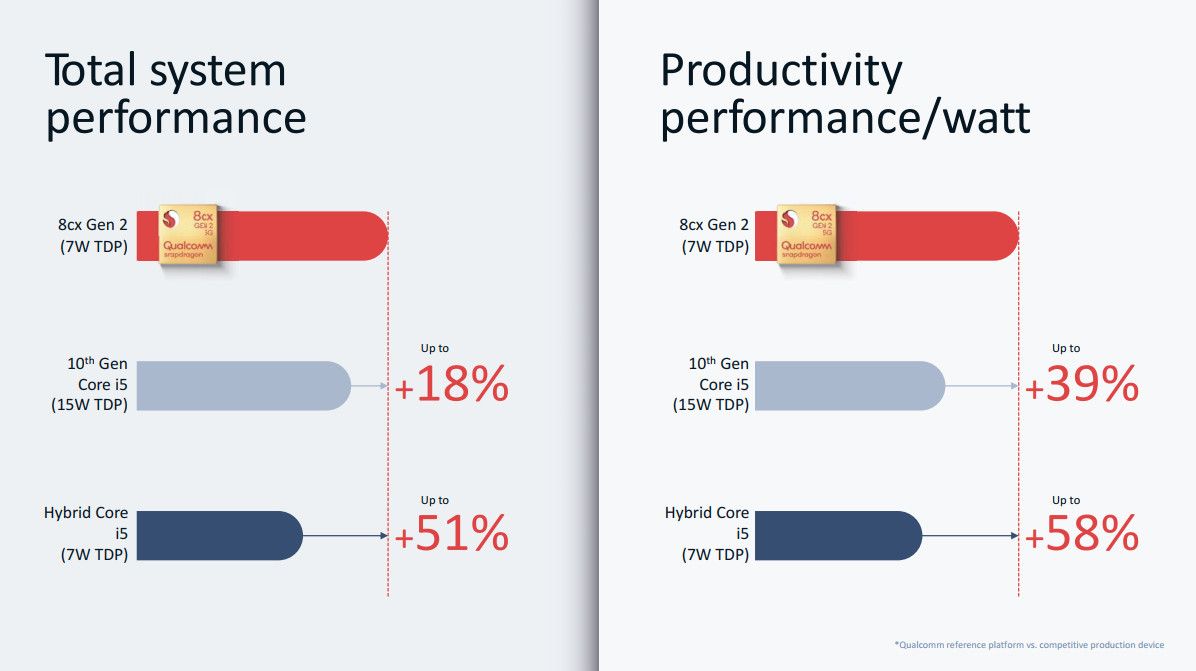
Other than that, there’s not much else that seems to be new. The chip is still fabricated on a 7nm FinFET process. Qualcomm says that the Snapdragon 8cx Gen 2 in a fanless 7W TDP design offers total system performance and productivity performance per watt that’s 18% and 39% greater respectively than a comparable 10th-gen Intel Core i5 15W TDP design.

Qualcomm Snapdragon 8cx Gen 2 modem Qualcomm Snapdragon 8cx Gen 2 camera

The Snapdragon 8cx Gen 2 5G compute platform is sampling now to customers and is expected to appear in commercial devices in late 2020. We’ve already seen laptops with the first-gen chip from Microsoft, Samsung, and Lenovo, but soon Acer will launch its first-ever Windows on Snapdragon PC powered by the new chip. So far, we haven’t seen any PC makers apart from Microsoft make use of Qualcomm’s AI Engine (Microsoft uses it to accelerate the Eye Contact feature in the Surface Pro X), but if the Snapdragon 8cx becomes more popular, then that could change.

The post Qualcomm announces the Snapdragon 8cx Gen 2 for “Always On, Always Connected” 5G PCs appeared first on xda-developers.


from xda-developers https://ift.tt/34YvCz5
via IFTTT

mercredi 2 septembre 2020

Nokia 2.1 and Xiaomi Redmi 8A Dual receive Android 10 update

Android 10 has now been out for close to a year, and Android 11 is just around the corner. Since last year’s Android release has been available for quite a while now, most flagship and mid-range smartphones that are eligible for an Android 10 update from their respective manufacturers have received the update. However, there are still many devices for which the update hasn’t rolled out yet—particularly some lower-end budget smartphones where updates are not as much of a priority as they are on more expensive devices. This, however, doesn’t mean that they’re necessarily going to be left behind. Now, two lower-end smartphones from HMD Global and Xiaomi (the Nokia 2.1 and the Redmi 8A Dual respectively) are getting updates to Android 10.

We are talking about two wildly different devices here, mind you. The Nokia 2.1 is an Android Go Edition smartphone that launched with Android 8.1 Go edition and got an update to Android 9 Pie Go Edition later down the road. It is powered by a Qualcomm Snapdragon 425 processor with just 1 GB of RAM and 8 GB of storage, so it’s hardly the most powerful option out there. Nonetheless, HMD Global has committed to providing 2 major updates for the entirety of its smartphone lineup, so even the budget Nokia 2.1 was due for an Android 10 update eventually. Since the update brings Android 10 Go Edition, you’ll be getting a stripped-down version of the Android 10 experience with special Go-optimized versions of Google apps. The update is rolling out now for 10% of users in several Asian markets, including in India, and will fully roll out to all users in the approved Asian markets by September 7th.

Nokia 2.1 Android 10 Go Edition Announcement

The Redmi 8A Dual from Xiaomi is a beefier budget device. It’s essentially a special (and India-exclusive) model of the Redmi 8A, featuring dual cameras instead of the single rear shooter that was included in the normal model. This phone features a slightly higher-end Snapdragon 439 processor with up to 3 GB of RAM and 32 GB of storage. Both the regular Redmi 8A and the Redmi 8 have already received Android 10, and now, the Redmi 8A Dual device is getting its own Android 10 update with MIUI 11. Those of you who are waiting for an update to MIUI 12 will have to wait for longer. You can download the OTA package by tapping the link below.

Download Android 10 for the Redmi 8A Dual

Has your device received its Android 10 update yet?

The post Nokia 2.1 and Xiaomi Redmi 8A Dual receive Android 10 update appeared first on xda-developers.


from xda-developers https://ift.tt/2GdD0fF
via IFTTT

Samsung Galaxy Z Fold 2 Hands on: Probably my favorite phone of the year

When the original Galaxy Fold began malfunctioning in the hands of major reviewers in April 2019, it seemed like Samsung’s vision of a foldable future had crashed before it could even start. But a relatively problem-free relaunch six months later, followed by the successful launch of a second foldable device, put Samsung back on track. Now, with the Galaxy Z Fold 2, Samsung’s making a strong case that the foldable form factor is not just here to stay, but should be the next evolution of smartphones.

Samsung Galaxy Z Fold 2 specifications (click to reveal the specs)

Specification Samsung Galaxy Z Fold 2
Dimensions & Weight
  • Folded: 159.2 x 68 x 16.8 mm
  • Unfolded: 159.2 x 128.2 x 6.9 mm
  • 282g
Display
  • Outer Display:
    • 6.23″ HD+ Super AMOLED
    • 2,260 x 816 pixels
    • 25:9 aspect ratio
    • Infinity-O
    • 60Hz refresh rate
    • HDR10+ support
  • Inner Display:
    • 7.6″ FHD+ Dynamic AMOLED 2X
    • 2,208 x 1,768 pixels
    • 22.5:18 aspect ratio
    • Infinity-O
    • 120Hz refresh rate
    • Dynamic refresh rate
    • HDR10+ support
SoC Qualcomm Snapdragon 865 Plus:
  • 1x Kryo 585 (ARM Cortex-A77-based) Prime core @ 3.1GHz
  • 3x Kryo 585 (ARM Cortex-A77-based) Performance core @ 2.4GHz
  • 4x Kryo 385 (ARM Cortex A55-based) Efficiency cores @ 1.8GHz

Adreno 650 (10% overclock)

RAM & Storage 12GB LPDDR5 + 256GB UFS 3.1
Battery & Charging
  • 4,500 mAh
  • 25W wired fast charging
  • 11W wireless charging
  • Reverse wireless charging
Fingerprint sensor Side-mounted fingerprint scanner
Rear Camera
  • Primary: 12MP, f/1.8, OIS
  • Secondary: 12MP, f/2.2, ultra-wide-angle
  • Tertiary: 12MP, f/2.4, telephoto
Front Camera
  • Folded: 10MP, f/2.2, fixed focus
  • Unfolded: 10MP, f/2.2, fixed focus
Other Features
  • Folding design
  • 5G: SA, NSA, mmWave
  • NFC
  • MST
Android Version Android 10 with One UI

Almost every issue (except for perhaps water resistance) that I and many other reviewers/consumers had with the original Fold is resolved with the Galaxy Z Fold 2. The outside “cover screen” is much larger; the inside screen got rid of the unsightly notch, and the hinge feels significantly more sturdy. There are also improvements in multitasking, closer partnerships with Google and Microsoft to optimize the experience, and further enhancements to the whole experience.

Galaxy Z Fold (left) vs Galaxy Fold (right)

That first change is the most crucial, in my opinion. As someone who writes and read on my phone often, I enjoyed using the Fold as my daily driver, but the 4.5-inch cover screen always felt too cramped, mainly when typing. It was a device I felt like I had to unfold to get real work done.

The Galaxy Z Fold 2’s 6.2-inch cover screen, because it feels much closer to a typical phone screen size, makes it easier to use, thus reducing the need to unfold the device every time. But you’ll want to unfold it whenever you have the chance because the inside screen is stunning: a 7.6-inch Samsung AMOLED panel with all the vivid colors and vibrant contrast that we expect from a Samsung flagship. The internal screen supports 1768 x 2208 pixels resolution and 120Hz refresh rate, while the external cover display features 816 x 2260 pixels resolution and 60Hz refresh rate.

The multitasking and typing experience on the Galaxy Z Fold 2

The same multitasking system from the first Fold returns, but everything feels more fluid and zippy. You can run up to three apps on the screen at once in split-view, and you can adjust orientation on the fly: for example, have two apps show vertically side-by-side or horizontally on top of each other. You can also drag and drop files and photos between native Samsung apps and Microsoft apps, for example, a photo from the gallery to Microsoft Outlook or Samsung’s messaging app.
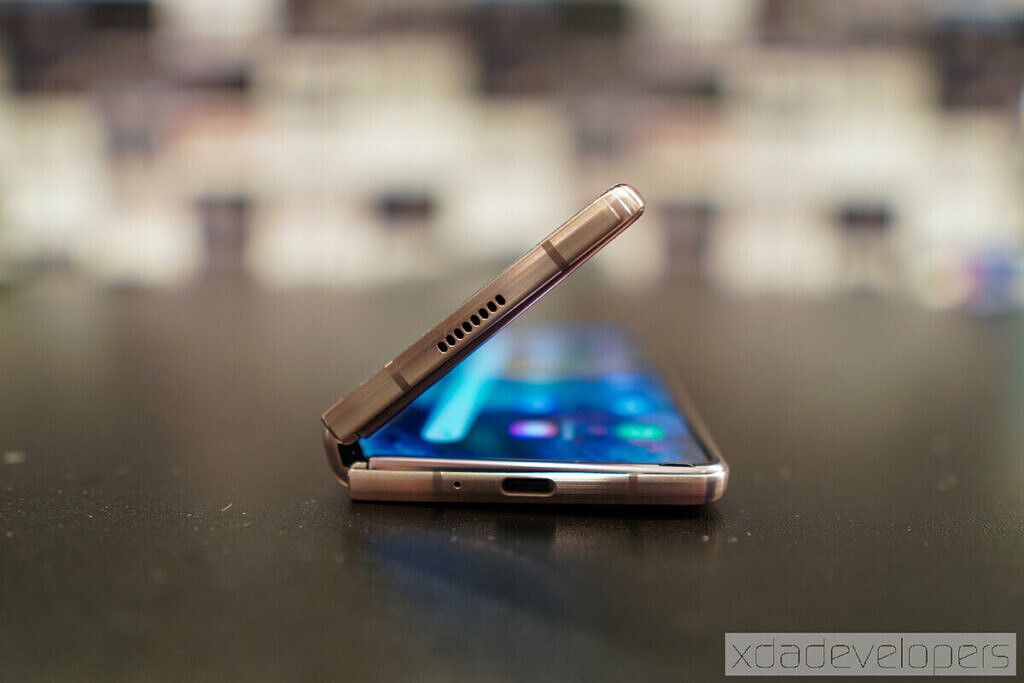
The new hinge lets you stop it at any angle

Another significant upgrade is the improved hinge, which, just like on the Z Flip, can now keep a partially folded angle. Samsung calls this “Flex Mode,” and it brings several new use cases, such as hands-free video calls or photo taking. Unlike the first Galaxy Fold, the hinge also feels far more refined and reliable, and the differences between the first and second generation Folds are immediately noticeable.

Samsung developed some new UI tricks to accommodate this new Flex Mode; certain apps will jump into a split view as soon as it’s partially folded. For example, in the YouTube app, you get a full-screen video when the device is opened all the way. But fold the device slightly, and the video jumps to the top half of the screen, with the bottom half showing video comments; other suggested videos, etc. While a marked improvement on the Galaxy Fold, it’s not 100% perfect as more apps need to be optimized to take full advantage of the real estate. For example, the Kindle app doesn’t allow you to display the pages in two individual columns split across the screen; instead, it’s full-screen only).

Another feature that makes a lot of sense given the phone’s form factor: you can take selfies using the primary camera system, with the cover screen as a camera viewfinder. Borrowed from the Galaxy Z Flip, it’s a nice improvement to have, especially as the dual selfie camera on the inside has been replaced with a single pinhole camera.

I didn’t get a chance to test the cameras, but the main system consists of a trio of 12-megapixel sensors, offering the usual wide, ultrawide, telephoto focal lengths. The latter camera can only do 2X optical zoom as opposed to 3X and 5X of the Note 20 and Ultra, respectively. Still, I suppose the foldable form factor made putting the latest camera components difficult. Still, I expect camera performance to be on par with the Galaxy Note 10 or Galaxy S20. Is the Galaxy Z Fold 2 going to have the best smartphone camera around? It almost certainly will not, but it should be good enough. Chances are, the camera isn’t the main reason you are buying a Galaxy Z Fold 2.

Unlike last year where some regions got 5G, and others got 4G, this year, all devices support 5G. You’ll also get the Snapdragon 865 Plus processor regardless of where you buy the Galaxy Z Fold 2; there’s no Snapdragon-Exynos split like on previous Samsung smartphones. There’s 12GB of RAM and either 256GB or 512 of storage, and it isn’t great to see Samsung half the base storage of the Galaxy Fold.

Ultimately, Samsung delivered the changes that were needed most. After just an hour with the device, I already know I want it as my daily driver, and barring an unlikely surprise from Apple or Huawei later this year, the Galaxy Z Fold 2 is shaping up to be my favorite phone of the year. It’s one of the most expensive devices of the year, but at $1,999, it’s only $20 more than the original Galaxy Fold despite the vast number of improvements it brings.

    Up to $800 instant trade-in credit at Samsung
    If you want to save a bundle on your unlocked Galaxy Z Fold 2 and have a recent phone, Samsung's trade-in offer is the best. You can get up to $650 credit and if you have the original Z Flip or Galaxy Fold, you can save $800 on your new Galaxy Z Fold 2!

You might also like:

The post Samsung Galaxy Z Fold 2 Hands on: Probably my favorite phone of the year appeared first on xda-developers.


from xda-developers https://ift.tt/2Goit8r
via IFTTT