LightBlog

lundi 7 septembre 2020

Today’s Top Tech Deals: Lenovo ThinkPad X1 Starting at $874, 2K Webcam for $21, and More!

Happy Labor Day to our U.S. readers! Are you enjoying the long weekend? Even if you’re working, you can count on one thing for a holiday like this–some great deals! That includes the awesome deals over at the XDA Developers Depot. Don’t miss out on those, as those great prices only last until the end of the day. Also, the new features Spotify are testing look great. Hopefully they’ll roll out soon.

Today’s top tech deals include a huge discount on the Lenovo ThinkPad X1 Carbon Gen 7, a $21 2K webcam, and more!

By the way, today is the last day of Satechi’s Labor Day Sale! Make sure to use the code SATLDAY15 at checkout to save 15% on your order.

Amazon Echo Buds for $90

If you’re invested in the Amazon ecosystem (and maybe even if you’re not), good news–Amazon’s Echo Buds are $40 off, down from $130 to $90. The selling point of these buds is that you can use Alexa with them, which gives you a hands free option to control music and other features. The Echo Buds don’t have the longest lasting batteries, which 5 hours of music playing on a single charge, but it’s up to you to decide what features are worth it!

    Echo Buds
    The Echo Buds provide Alexa support and are exercise ready with a snug fit and sweat resistance. With $40 off, are these the ear buds you've been waiting on?

14″ Lenovo ThinkPad X1 Carbon Gen 7 for $874

Lenovo notes that their ThinkPad X1 is “styled for premium performance”, and I don’t think they’re blowing any smoke. The base model of the ThinkPad X1 Carbon Gen 7 comes with a 14″ monitor, 8 GB RAM, and a 256 SSD. By using the code CLEAR8, you can get this model for $874, a whopping $755 off the laptop MSRP. Of course, if you need more power, you can upgrade the parts of the laptop you need to before checking out–and you can still use the code to save.

Walfront’s 2K Webcam for $21, Code Expiring Soon

Webcams have been in very high demand since quarantines have begun, and the need has only risen with some jobs and schools requiring a webcam for their meetings and classes. If you’re struggling to had a webcam of decent quality that won’t break the bank, Walfront’s 2K webcam may be the answer. In addition to the 2K, the webcam also has dual microphones that reduce background noise and a privacy cover. By clipping the coupon on the page and entering the code X2RS8Z64 at checkout, this webcam is only $21. It’s not the most high-tech or powerful webcam around, but it’ll definitely work for Zoom calls and Google Hangouts!

    Walfront 2K Webcam
    It may not be Logitech, but Walfront's webcam will get the job done (and I haven't any of Logitech's webcams at a reasonable price for ages). Clip the coupon and use the code X2RS8Z64at checkout, but act fast--the code will be expiring soon!

Razer Kraken Gaming Headset for $65

It’s very, very green, but also very great! At Target, you can grab the Razer Kraken Gaming headset for $65, which is $15 off the $80 MSRP. The microphone has noise cancelling technology built in, and the ear cups looks build for both great sound and comfort. They may not be ideal ‘work meeting’ headsets due to the design, but they’ll definitely be wonderful gaming devices!

    Razer Kraken Gaming Headset
    With immersive audio and a mic that'll cancel out background noises, the Razer Kraken headset is a good investment. I just hope you like green!

Samsung EVO Select 256GB microSD, $18 Off

If you need a little extra space for your smartphone or Nintendo Switch, but don’t really need 1TB of room, the Samsung EVO Select 256GB is probably more your speed. Right now, it’s $18 off at Amazon, so you can get the microSD for just $32. Samsung is, of course, a trusted brand, so you don’t need to worry about quality here.

    Samsung EVO Select 256GB microSDXC
    Need space, but not that muchspace? Grab this Samsung EVO Select 256GB microSD for $32. You won't be disappointed by its 100MB/s read and 90MB/s write speeds!

More Tech Deals

Looking for even more tech deals? We have them for you below! The SanDisk 1TB MicroSD went up $25, but it’s still $190 off, so the purchase is still worth it. The Dell curved monitor, on the other hand, has dropped about $5. If you waited until now to pick it up, now you can treat yourself to a coffee with the extra savings!

The post Today’s Top Tech Deals: Lenovo ThinkPad X1 Starting at $874, 2K Webcam for $21, and More! appeared first on xda-developers.


from xda-developers https://ift.tt/3h299DK
via IFTTT

There might not be a OnePlus 8T Pro this year

The OnePlus hype train has departed the station once again with the destination set to the OnePlus 8T launch event. In the last few days, we’ve seen a partial spec sheet of the device as well as what the front of the phone will look thanks to a leaked render. We expect the phone will have the Qualcomm Snapdragon 865 Plus, a 6.55-inch 120Hz OLED display, 48MP quad camera setup, and Android 11 with OxygenOS 11 out of the box. We also learned that the company could be planning to announce its first smartwatch, which could be called the OnePlus Watch. But there’s been a distinct lack of leaks for the OnePlus 8T Pro model. There’s no mention of such a device even in OnePlus’s OxygenOS 11 firmware, where the 8T render was found. It turns out, there might not be an 8T Pro model at all.

We raised this possibility last week in our article about the leaked 8T spec sheet. We mentioned that, while we had found plenty of evidence for a OnePlus 8T “kebab” model with a “kebabt” (likely U.S. T-Mobile) variant, we couldn’t find any references to other “kebab” variants, most notably “kebabp” or “kebab2.” The latter two would be indicative of the existence of a “Pro” model as is customary with OnePlus’s code-name naming scheme.

Known leaker Max J took to Twitter today corroborating that there won’t be a “kebab2”. Then, he replied to someone confirming that he was indeed talking about the lack of a OnePlus 8T Pro model. Add this to the fact that we haven’t really seen any leaks for a Pro model yet, and everything starts to make more sense. While you can still attribute the lack of leaks for a Pro model to the possibility that nothing has simply been discovered yet, the odds are looking quite grim as our own digging has shown, the proximity to the launch date, and Max J’s stellar track record on OnePlus leaks.

Last year’s OnePlus 7T Pro seemed like “more of the same” to Adam, as he noted in his review. It was pretty much the same phone as the OnePlus 7 Pro, with very few improvements. The OnePlus 7T, though, was the real star of the show as a marked upgrade over the OnePlus 7. It is possible that the same situation would’ve happened with an OnePlus 8T Pro, which is perhaps why the company may have scrapped it. The McLaren partnership also ended a few months back, so if the phone did indeed see the light of day, there wouldn’t be a McLaren edition of it.

The OnePlus 8 Pro is already an excellent device in a lot of regards, though. So if you really need the extras that come with a Pro model, you might consider looking at that instead. After all, the OnePlus 7T Pro shared 95% of its DNA with the OnePlus 7 Pro, so you wouldn’t really be missing out on a lot.

The post There might not be a OnePlus 8T Pro this year appeared first on xda-developers.


from xda-developers https://ift.tt/2ZflEG0
via IFTTT

Spotify is testing local Group Sessions, auto-refresh for playlists, saving podcast episodes, 30-minute offline listening for free users, and more

Spotify, the music streaming platform used by nearly 300 million people globally, is currently testing a string of new features that could be announced soon. These include an expansion to the Group Sessions feature for local networks, auto-refresh for playlists, the ability to save podcast episodes, 30-minute offline listening for free users, and more.

Reverse engineer Jane Manchun Wong, who is famous for hacking applications and software to find new features being developed by technology companies, made these discoveries and took to Twitter to share several screenshots of some of the exciting functionalities and enhancements that Spotify has been working on.

One of the biggest changes that could be coming to the music streaming service is the ability for free users to listen to music offline for 30 minutes daily. Currently, offline streaming is reserved for paying subscribers, while users with a free subscription can only use the platform if they have an Internet connection. But if this change comes to fruition, they’ll be able to stream music for half an hour each day without a mobile or Wi-Fi connection.

If you use Spotify for listening to podcasts, you’re in luck as Spotify is developing a feature called “Your Episodes”. Using this, you’ll be able to save specific episodes of your favorite podcasts to listen to again or when you have time to catch up on them. Another neat functionality is “auto-refresh” for playlists, which users would be able to enable if they want their playlists to refresh and new songs to be added automatically.

Spotify has a new homepage for its car mode in the pipeline, too. Jane wrote on Twitter that this will include “larger grids of recommended playlists, a banner telling users they can control Spotify via Google Assistant, [and] a redesigned navigation bar for Car Mode.” Finally, she also showed off a new player UI for Spotify Car Mode, and it looks great.

The new features have yet to be confirmed by Spotify, so it’s worth pointing out that they won’t necessarily appear in the next stable version of the streaming service. Jane discovers new features days, weeks, months, or even close to a year before their public launch, so there’s no telling when these features will go live.

Spotify: Listen to new music, podcasts, and songs (Free, Google Play) →

The post Spotify is testing local Group Sessions, auto-refresh for playlists, saving podcast episodes, 30-minute offline listening for free users, and more appeared first on xda-developers.


from xda-developers https://ift.tt/333y4BP
via IFTTT

The Google Pixel 4a gets its first custom ROM and kernel

After literally months of leaks and pushbacks (with most of those pushbacks caused by the ongoing pandemic), the Pixel 4a finally became a reality some weeks ago. After Google’s success with the Pixel 3a lineup — which brought average mid-range specifications and paired them with the very same camera prowess you’ll find on high-end Pixel smartphones and the same excellent software goodies and support — Google wanted to do it again, and so they did. The Pixel 4a an updated design with a front-facing hole-punch camera, a Snapdragon 730 processor, and, of course, possibly the very best camera in its price segment. Oh, and it’s also very easy to mod these phones, in case you forgot. So guess what? We now have both a custom ROM and custom kernel for the Pixel 4a.

Google Pixel 4a XDA Forum

Best Pixel 4a Deals: How to order Google’s budget beast

You might say that, since the phone runs stock, honest-to-Google Android, there’s really no need for custom ROMs. But this is Resurrection Remix: it cherry-picks features and changes from several custom ROM projects. It’s still based on stock Android (AOSP), but it also manages to provide serious customization capabilities as well as features you won’t find on the phone’s stock software (Google’s Android).

Resurrection Remix v8 for the Pixel 4a

We also have the HolyDragon Kernel, a custom kernel project based on Google’s source code. It’s compiled using Google Clang 11.0.1 at the time of writing, it’s already preconfigured with the most optimal settings (so you don’t need any tweaking after flashing — it’s ready out-of-the-box), and it comes with a lot of features, most of them geared towards stability and performance. You have features such as KCAL support, Boeffla Wakelock Blocker, NTFS RW support, exFAT support, and more. According to the developer, it’s still a “work-in-progress” in terms of features, but the kernel itself is marked as stable. Oh, and it also comes pre-installed on the Resurrection Remix builds I mentioned earlier, so if you’re flashing that to your device, there’s no need to download the kernel separately.

HolyDragon Kernel for the Pixel 4a

The post The Google Pixel 4a gets its first custom ROM and kernel appeared first on xda-developers.


from xda-developers https://ift.tt/3ici2fm
via IFTTT

[Update: Confirmed] LG may show off its dual screen “Wing” smartphone on September 14th

Update 1 (09/07/2020 @ 09:43 AM ET): LG has confirmed that the dual-screen smartphone will be called Wing and will be unveiled next week. Scroll to the bottom for more information. The article as published on September 2, 2020, is preserved below.

In a blogpost today, LG has revealed details about kicking off its new Explorer Project along with a video teaser of what’s believed to be its crazy LG Wing smartphone. LG describes the new Explorer Project as “both an initiative and a category and will include devices that deliver distinctive and yet unexplored usability experiences.” The announcement will take place on September 14 at 10:00 (EDT) and will be streamed on LG Mobile’s YouTube channel and Facebook page.

LG says the new Explorer Project will solely focus on discovering new usabilities and bringing innovative smartphone designs. In contrast, its “Universal Line” will focus on delivering competitive devices such as the LG Velvet.

Although LG hasn’t yet officially revealed much info about the LG Wing, we already know quite a few bits about this upcoming smartphone, including its design, form factor as well as a possible price. A report from ETNews back in May gave us our first glimpse at this crazy dual-screen smartphone. As per the report, the LG Wing will feature a radical dual-screen design in which the secondary screen swivels horizontally behind the main display. This was followed by a release of two leaked video clips, which demonstrated how LG plans to utilize the dual-screen setup for different use cases.

As for availability, LG Wing is expected to be first launched in its home country South Korea. However, the company also plans to bring it to the US market subsequently. As per our source, the LG Wing will hit the US shores this fall and will be priced around $1000.

LG Wing XDA Forums

Information regarding the exact specifications of the Wing remains unknown. However, if the ETNews report is to be believed, the LG Wing will have a 6.8-inch primary display, a 4-inch secondary display, a triple camera setup featuring a 64MP primary sensor, and a Snapdragon 700-series processor with 5G support (likely the Snapdragon 765 or Snapdragon 768G).

Source: LG Newsroom


Update: LG confirms its “Wing” dual-screen smartphone will be unveiled next week

LG has confirmed that the dual-screen phone will be called the LG Wing.

Source: LG Newsroom

The post [Update: Confirmed] LG may show off its dual screen “Wing” smartphone on September 14th appeared first on xda-developers.


from xda-developers https://ift.tt/31QKaz1
via IFTTT

Xiaomi unveils the POCO X3 NFC with a 120Hz display, Qualcomm Snapdragon 732G, and 64MP quad camera

A certification listing of a new POCO device popped up late last month, revealing that the company was finally planning on launching something original. The listing showcased a device with a new back panel design that we hadn’t seen on any existing Xiaomi smartphone, and it confirmed that the device would feature a 64MP primary camera. A SAR test report for the device also revealed that it would pack in a 5,160mAh battery and include support for 33W fast charging. Even though the listings didn’t reveal the marketing name for the device, our internal sources suggested that it would be called the POCO X3. As expected, Xiaomi’s subsidiary has now officially unveiled the POCO X3 NFC, and it’s powered by Qualcomm’s latest mid-range Snapdragon 732G chipset.

POCO X3 NFC: Specifications

Specification POCO X3 NFC
Dimensions & Weight
  • 165.3 x 76.8 x 9.4mm
  • 215g
Display
  • 6.67-inch FHD+
  • 2400x1080p
  • 120Hz refresh rate
  • 240Hz touch sampling rate
  • 1500:1 contrast ratio
  • TÜV Rheinland Low Blue Light certified
  • HDR10
  • 450nits peak brightness
SoC Qualcomm Snapdragon 732G
RAM & Storage
  • 6GB LPDDR4x + 64GB UFS2.1
  • 6GB+128GB
Battery & Charging
  • 5,160mAh
  • 33W wired fast charging
  • 33W charger included in box
Fingerprint sensor Side-mounted fingerprint scanner
Rear Camera
  • 64MP f/1.89 Sony IMX682 primary camera
  • 13MP f/2.2 wide-angle camera, 119-degree FoV
  • 2MP f/2.4 macro sensor
  • 2MP f/2.4 depth sensor
Front Camera 20MP f/2.2 selfie camera
Other Features
  • IP53 dust and water resistance
  • 3.5mm headphone jack
  • USB Type-C
  • Dual stereo speakers
  • Hybrid SIM slot for microSD cards up to 256GB
  • LiquidCool Technology 1.0 Plus
    • Copper heat pipe+graphite
  • Wi-Fi 5
  • Bluetooth 5.1
  • NFC
Android Version MIUI 12 for POCO based on Android 10

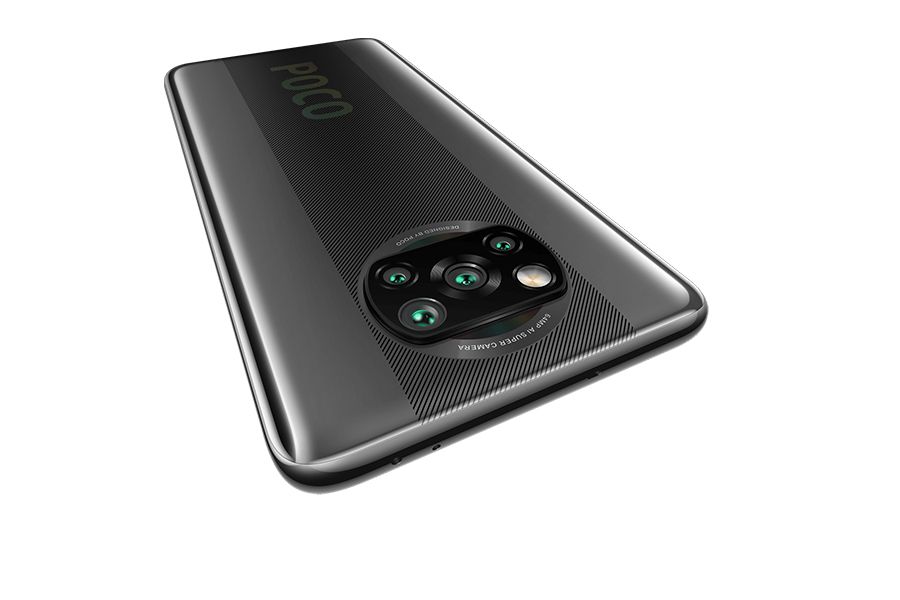
The new POCO X3 NFC features a completely new design with a rectangular camera module on the back, large POCO branding right down the center, and a nearly bezel-less display with a hole-punch cutout for the selfie camera. As mentioned earlier, the device is powered by the new Qualcomm Snapdragon 732G chip, which consists one Kryo 470 “Prime” core clocked at up to 2.3GHz, one Kryo 470 “Performance” core clocked at up to 2.2GHz, and six Kryo 470 “Efficiency” cores clocked at up to 1.8GHz. The microarchitecture of the Prime and Performance cores are based on ARM’s Cortex-A76 design, while the microarchitecture of the six Efficiency cores is based on ARM’s Cortex-A55 design. The Snapdragon 732G packs in the Adreno 618 GPU, which boasts of 15% better graphics performance than the Adreno 618 on the Snapdragon 730G chipset.

POCO X3

The POCO X3 NFC packs in a 6.67-inch FHD+ LCD DotDisplay with a resolution of 2400×1800 pixels, 120Hz refresh rate, and 240Hz touch sampling rate. The display features a centered hole-punch cutout for the selfie camera, and it comes with TÜV Rheinland Low Blue Light and HRD10 certification. To ensure users have a great experience while using the device, the display on the POCO X3 offers a contrast ratio of 1500:1, and it covers 84% of the NTSC color gamut and 87.4% of the DCI-P3 color gamut. The display offers a peak brightness of 450nits and a minimum brightness of 380nits, which guarantees excellent visibility even in direct sunlight. To prevent scratches in daily use, the display is protected by Corning’s Gorilla Glass 5.

POCO X3

For your photography needs, the POCO X3 NFC packs in a quad-camera setup on the back with a 64MP Sony IMX682 f/1.89 primary sensor, a 13MP wide-angle sensor with a 119-degree FoV, a 2MP macro sensor, and a 2MP depth sensor. Over on the front, the device features a 20MP f/2.2 selfie shooter. The device has an aluminum alloy frame with a polycarbonate back panel, and it comes with IP53 certification for dust and water resistance. All the hardware buttons on the device are located on the right edge, with the fingerprint scanner built into the power button.

As mentioned in previous leaks, the POCO X3 NFC packs in a 5,160mAh battery with support for 33W fast wired charging. The device will ship with a 33W charger in the box, which will connect to the device over USB Type-C. Right next to the USB Type-C port on the bottom edge, the device also features a 3.5mm headphone jack. Other connectivity options include Wi-Fi 5, Bluetooth 5.1, and NFC. On the software front, the device runs MIUI 12 for POCO based on Android 10.

Pricing & Availability

The POCO X3 NFC will be available in two RAM/storage variants, which have been priced as follows:

  • 6GB + 64GB: €229
    • Early Bird offer: €199
  • 6GB + 128GB: €269
    • Early Bird offer: €249

The device will be available in two color variants — Shadow Gray and Cobalt Blue.

It will go on sale starting from September 8, 2020, across Europe.

POCO is expected to launch the device in the Indian market as well. However, we currently have no information on the release timeline or pricing details for the region.

The post Xiaomi unveils the POCO X3 NFC with a 120Hz display, Qualcomm Snapdragon 732G, and 64MP quad camera appeared first on xda-developers.


from xda-developers https://ift.tt/2ZdfXIL
via IFTTT

Realme UI based on Android 10 to finally receive multi-user support

With the launch of the Realme X50 5G earlier this year, Realme debuted Realme UI — the company’s custom Android software based on Android 10. The new software was well received by users and reviewers alike, and it has managed to create a loyal fanbase over the last couple of months. But while Realme UI offers users an Android experience that’s closer to stock Android than OPPO’s ColorOS, it doesn’t include a crucial stock Android feature that’s available on most other Android ROMs — multi-user support.

Google rolled out multi-user support in Android with Android 5.0 Lollipop about 5 years ago and, since then, most Android OEMs have offered multi-users support on their custom Android software. Surprisingly, Realme isn’t one of those OEMs. The company’s Realme UI doesn’t include any options to set up multiple user profiles, which can prove to be a major inconvenience for users with shared Android devices. However, that might change soon.

Realme UI multi-user support

According to a recent post on Realme’s community forums, multi-user support will soon make its way to all Realme devices running Realme UI based on Android 10. Once released, the feature will allow Realme users to set up multiple user profiles. In effect, the feature will let two or more users share the same device, and have their own set of unique apps, wallpapers, and files.  This will ensure privacy for each user, even though they share the same phone.

As of now, it isn’t clear when the feature will roll out to Realme devices running Realme UI based on Android 10. But once it does show up on your phone, you’ll be able to access it by navigating to Settings > Users & Accounts > Multi-user > Add user. The feature will also add a toggle to help you quickly switch users from the notifications center. In case you don’t wish to wait for the update, you can follow this guide to enable multi-user support with a build.prop mod on rooted devices.


Source: Realme community forums

Via: PiunikaWeb

The post Realme UI based on Android 10 to finally receive multi-user support appeared first on xda-developers.


from xda-developers https://ift.tt/2ZfFWiv
via IFTTT